Using a campsite as your permanent address in the UK
Discover the role of campsite as permanent address in the UK. Learn why a campsite cannot serve as a legal address for official documents.
Using a campsite as your permanent address in the UK
A campsite address cannot serve as a legal permanent address in the UK. Whether you live full-time in a motorhome, static caravan, or park model trailer, government bodies including the DVLA, HMRC, and local electoral offices require a fixed, physical street address for official documentation. Understanding this distinction early saves you a great deal of frustration down the road.
Can a campsite be used as a permanent legal address in the UK?
The short answer is no, and the reason comes down to zoning. Campsite addresses are not legally recognised as permanent residences in the UK because recreational land is classified differently from residential land. A campsite pitch number or site address simply does not meet the criteria that government databases require.
Most recreational campgrounds also lack the infrastructure needed for year-round habitation, including frost-proof plumbing and heavy-duty electrical systems designed for winter heating loads. That physical shortfall reinforces the legal one.
Here is what a campsite address covers and what it does not:
- Accepted uses: receiving personal post informally, booking site facilities, and identifying your pitch location within the site
- Not accepted for: DVLA driver’s licence applications or vehicle registration, voter registration, HMRC tax filings, NHS GP registration, or bank account applications
- Not accepted for: insurance policies requiring a residential address, or any official document demanding a fixed domicile
Planning permission and legal considerations for permanent motorhome living
Living permanently in a motorhome or caravan on a campsite without the correct planning permission carries real legal risk. Recreational campgrounds are zoned for leisure use, not residential occupation, and local councils can and do enforce this distinction.

If a campsite were reclassified to allow permanent residency, it would typically need to be redesignated as a mobile home park, which changes the planning obligations and tax position for the site owner entirely. Zoning regulations are the primary barrier to claiming a campsite pitch as a legal home.
Key legal points to keep in mind:
- Recreational campgrounds in the UK are taxed and regulated differently from residential land
- Many sites impose maximum stay durations, often requiring guests to maintain a separate legal address
- Claiming a campsite as your domicile without proper zoning can trigger tax complications and council enforcement action
- A German court ruling in 2007 confirmed that caravans at campsites are distinct from permanent homes and generally exempt from second-home tax, but this does not confer residential status
Practical aspects of living long-term at a campsite
Long-term campsite living is genuinely comfortable when you choose the right site. Modern campgrounds serving extended-stay guests often provide full utility hookups, on-site laundry, and community spaces that make daily life feel settled and sociable. Campground operators increasingly recognise long-term guests as a distinct group requiring enhanced services and proactive communication.
That said, the practical challenges are real. Campground offices are unreliable as sole mail-handling points due to limited opening hours and staff turnover. You will need to manage utilities, insurance, and official correspondence independently rather than relying on reception services.
Practical considerations for long-term campers:
- Confirm the site offers full hookups: water, electricity, and sewage connections
- Check the site’s maximum stay policy before committing
- Arrange a separate legal address for all official correspondence
- Set up a mail forwarding service rather than using the campsite office as your postal address
- Build relationships with campsite management to understand what resident support is actually available
Types and advantages of accommodation used in permanent camping
Mobile homes, static caravans, and park model trailers offer a meaningful step up from standard RV living. These accommodation types provide better comfort, more reliable utility connections, and stronger community integration than tent or basic motorhome setups.
Static caravans and mobile homes typically include full kitchen facilities, proper bathrooms, and insulated walls suited to year-round occupation. Park model trailers, as seen at sites like Coastal Acres in Provincetown, often feature the only year-round water and sewer hookups on a campground.
Accommodation options and their key advantages:
- Mobile homes: spacious layouts, full utility hookups, and a sense of permanence without the costs of traditional property ownership
- Static caravans: lower entry price, good community integration, and flexibility to sell or relocate
- Park model trailers: compact but well-equipped, often with year-round infrastructure and personalised outdoor spaces
Camping Les Prairies du Lac in the Vendée region of France is a strong example of what permanent camping accommodation can look like at its best. Caravansinfrance offers pre-owned mobile homes at this four-star site, with heated pools, community activities, and a warm coastal microclimate. It is the kind of setting that makes long-term campsite living genuinely appealing.
What are the best alternative legal addresses for full-time RV residents?
Since a campsite pitch cannot serve as your legal domicile, you need a workable alternative. The most reliable solution for full-time UK RVers is a commercial mail forwarding service that provides a real, physical street address rather than a P.O. box. Government bodies reject P.O. boxes and campsite site numbers automatically.
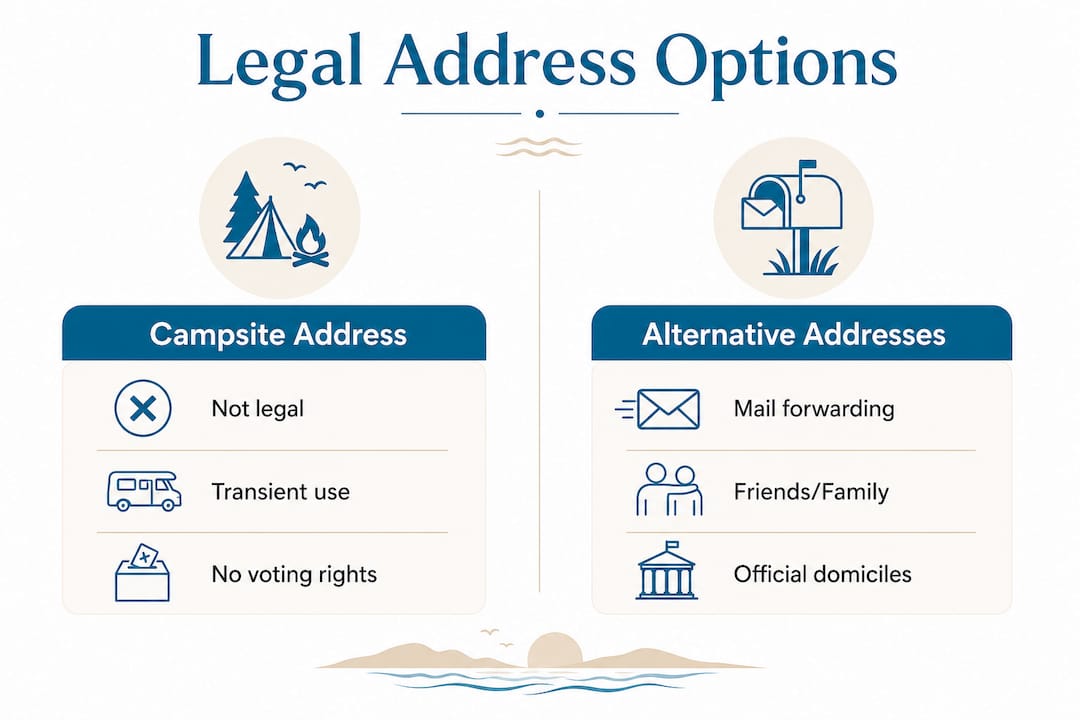
A trusted friend or family member’s address can work, but only with proper legal steps in place. Without those, both parties risk tax complications and potential fraud concerns.
Alternative address options:
- Commercial mail forwarding services: provide a physical street address accepted by the DVLA, HMRC, and banks; the standard solution for full-time RVers
- Trusted residential address: a family member’s home used with their full knowledge and legal agreement
- P.O. boxes: not accepted by government bodies or most insurers
- Campsite site numbers: automatically rejected by official databases
Pro Tip: When choosing a domicile address, pick a location where you can genuinely demonstrate a connection, such as a county where you receive healthcare or pay council tax. This reduces the risk of challenges from HMRC.
How a campsite address affects your official documents
Your driving licence, vehicle registration, passport correspondence, and bank statements all require a fixed residential address. State agencies require a physical street address to process these documents, and a campsite pitch number triggers automatic rejection in official systems.
The practical consequence is that full-time campers must maintain a legal domicile address separately from where they physically sleep. This is not a loophole; it is the standard arrangement for the majority of long-term RV residents across the UK.
How to register to vote using a campsite address
You cannot register to vote using a campsite address alone. Electoral registration in the UK requires a fixed residential address, and a pitch number does not qualify. The solution is to register using your legal domicile address, whether that is a mail forwarding service address, a family member’s home, or another qualifying residential address.
Some local councils accept declarations of local connection for people without a fixed home, which can allow registration in the area where you spend most of your time. Contact your local electoral registration office directly to explore this option.
How mail forwarding works for permanent campers
Mail forwarding services give you a real street address that government bodies, banks, and insurers accept. Your post arrives at the forwarding address and is then scanned, held, or redirected to wherever you are parked. This arrangement keeps your official correspondence organised without depending on campsite reception.
The key is choosing a service that provides a genuine physical address, not a P.O. box. Many experienced full-timers also use the forwarding address as their legal domicile for driving licence and vehicle registration purposes.
How campsite living affects your access to healthcare
GP registration in England requires a fixed address within the practice’s catchment area. Living full-time at a campsite complicates this, as a pitch number does not satisfy the registration requirement. Using your legal domicile address resolves this for routine registration, though accessing local NHS services while travelling between sites requires some planning.
NHS 111 and walk-in centres remain accessible regardless of your registered address, which provides a useful safety net for urgent care needs while you are on the move.
Insurance implications of using a campsite as your address
Insurers treat campsite addresses as transient locations, not permanent residences. Using a pitch number as your home address on a vehicle, contents, or health insurance policy can invalidate your cover if the insurer discovers the address does not qualify as a legal domicile.
The solution is to use your legal domicile address for all insurance purposes and to be transparent with your insurer about your full-time campsite lifestyle. Specialist motorhome and caravan insurers understand this arrangement and can tailor policies accordingly. Always disclose your living situation honestly to avoid a claim being refused.
Thinking about making the move to a more relaxed, permanent camping lifestyle in France? Caravansinfrance has a range of mobile homes for sale at Camping Les Prairies du Lac in the Vendée, ready to move into with no hidden fees or property taxes. Warm evenings, a heated pool, and a welcoming community are waiting.
Key takeaways
A campsite address is not a legal permanent address in the UK; full-time RV residents must maintain a separate legal domicile for all official documentation, voter registration, and insurance purposes.
| Point | Details |
|---|---|
| Campsite addresses are not legally recognised | UK government bodies reject campsite pitch numbers for driving licences, voter registration, and tax filings. |
| Zoning is the core barrier | Recreational land classification prevents campsites from qualifying as residential domiciles under planning law. |
| Mail forwarding is the standard solution | A commercial mail forwarding service provides the physical street address that official bodies require. |
| Insurance requires a legal domicile | Using a campsite address on insurance policies risks invalidating cover; always use your legal domicile address. |
| Mobile homes offer the best permanent camping experience | Static caravans and mobile homes provide comfort, utility hookups, and community life without traditional property costs. |