
Why mobile homes have no property chain in the UK
Discover why no property chain mobile home transactions are easier in the UK. Learn about streamlined buying without conveyancing hassles.
Why mobile homes have no property chain in the UK
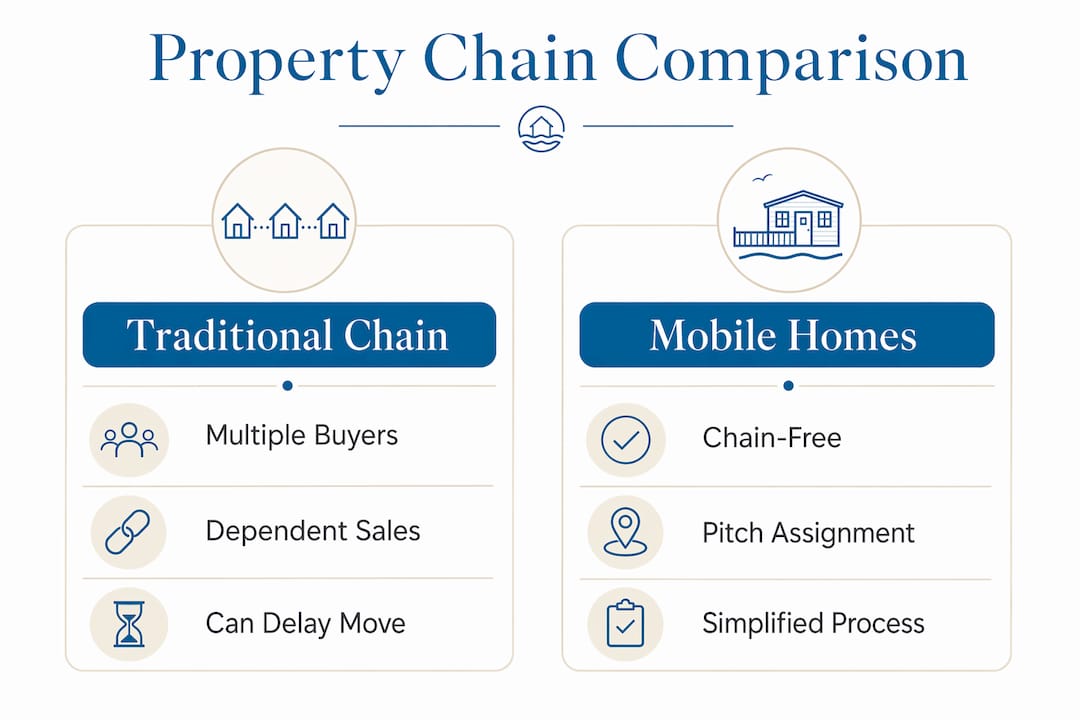
Mobile homes in the UK typically have no property chain because they are legally classified as chattel, or personal property, rather than real estate. That single legal distinction removes the entire mechanism that creates chains in traditional bricks-and-mortar sales.
Here is what that means in practice:
- No land ownership transfer. When you buy a mobile home, you buy the structure itself. The pitch (the plot it sits on) remains owned by the site owner. Because no land changes hands, there is nothing for the UK Land Registry to record.
- No traditional conveyancing. Without a land transfer, the lengthy legal process of conveyancing simply does not apply. There are no searches, no Land Registry fees, and no drawn-out contract exchanges between solicitors.
- Assignment of a pitch agreement, not a deed. Under the Mobile Homes Act 1983, the transaction involves assigning the seller’s pitch agreement to the buyer. It is a contractual handover, not a conveyance of land title.
- Direct sale between two parties. Because the transaction is self-contained, it does not depend on anyone else completing their own purchase first. There is no chain of linked sales to manage.
- Faster, simpler completion. Transactions can complete in weeks rather than the months typical of traditional property sales, with far less legal complexity and cost involved.
The result is a buying experience that feels refreshingly straightforward compared to the stress most people associate with moving house.
What is a property chain and how does it work?
A property chain is a linked series of dependent property sales, where each transaction can only complete when the one before it does. It begins with a buyer who has no property to sell, often a first-time buyer, and ends with a seller who has no onward purchase to make. Everyone in between is simultaneously buying and selling.
The UK Land Registry sits at the heart of every traditional transaction, registering the transfer of land ownership from seller to buyer. Because each transfer must be formally recorded, and because mortgage lenders, solicitors, and surveyors all need to complete their own checks before exchange, the process is inherently sequential. One party’s delay becomes everyone’s delay.

| Stage | Who is involved | What happens |
|---|---|---|
| Offer accepted | Buyer and seller | Provisional agreement; no legal commitment yet |
| Solicitors instructed | Both parties’ solicitors | Searches, enquiries, and title checks begin |
| Mortgage approved | Buyer’s lender | Formal offer issued after valuation |
| Survey completed | Buyer’s surveyor | Structural and condition report produced |
| Contracts exchanged | All parties in the chain | Legally binding; completion date set |
| Completion | All parties | Funds transfer; keys handed over; Land Registry notified |
Every row in that table must happen for every party in the chain before anyone can move. A chain of four or five households means four or five sets of solicitors, lenders, and surveyors all working in parallel, each capable of stalling the whole process.
What causes property chains to slow down or break?
Chains collapse more often than most buyers expect, and the reasons are rarely dramatic. The most common causes are quiet, procedural, and frustratingly preventable.
- Mortgage delays or rejections. A lender taking longer than expected to issue a formal offer, or declining an application after a valuation, can freeze the entire chain.
- Failed surveys. A structural problem uncovered by a surveyor often triggers renegotiation or withdrawal, particularly if the buyer’s lender then revises its offer.
- Buyers or sellers changing their minds. Until contracts are exchanged, either party can walk away with no legal penalty. A change of heart at any point in the chain affects everyone connected to it.
- Timing incompatibilities. One party may need to complete in six weeks; another may need three months. Reconciling those timelines across a chain of several households is genuinely difficult.
- Gazumping or gazundering. A seller accepting a higher offer from a new buyer, or a buyer reducing their offer at the last moment, can destabilise or destroy a chain that had been progressing smoothly.
A failed chain causes cascading delays that affect every buyer and seller connected to those linked transactions. Solicitor fees already paid, survey costs, and removal bookings can all be lost. The emotional toll is considerable too.
What is a chain-free property and why does it matter?

A chain-free property is one where the seller has no onward purchase to complete. They may be moving into rented accommodation, relocating abroad, or, in the case of a mobile home, simply selling a chattel with no land title attached. The buyer, equally, may be purchasing without needing to sell their existing home first.
Chain-free transactions offer faster completions, less risk of collapse, and simpler legal procedures. The key advantages for buyers are:
- Predictable timelines. Without dependency on other transactions, you can plan your move with genuine confidence.
- Lower risk of losing costs. Survey fees, legal advice costs, and mortgage arrangement fees are far less likely to be wasted if the sale does not fall through.
- Reduced legal complexity. Fewer parties mean fewer opportunities for miscommunication, missed deadlines, or conflicting requirements.
- Less stress. The emotional weight of waiting for a chain to hold together is one of the most cited frustrations in UK property buying.
Consider the contrast: a buyer purchasing a three-bedroom house in a chain of four households might wait six months or more, with no guarantee of completion. A buyer purchasing a mobile home without a chain can realistically complete in a matter of weeks, with a clear process and far fewer moving parts.
How can you avoid or speed up a property chain?
Whether you are buying a traditional property or exploring mobile homes, a few practical steps make a real difference to how smoothly a transaction runs.
- Arrange mortgage pre-approval before you start searching. A decision in principle from your lender signals to sellers that you are a serious buyer and removes one of the most common sources of delay.
- Choose chain-free properties wherever possible. Sellers with no onward purchase, new builds, and mobile homes all remove the dependency that creates chain risk. Chain collapse risk drops sharply when you are not relying on a sequence of other completions.
- Instruct a proactive solicitor or conveyancer early. The Law Society of England and Wales recommends that buyers and sellers take professional advice to meet statutory obligations correctly and avoid disputes.
- Communicate clearly and regularly with all parties. Chains stall when information stops flowing. A weekly check-in with your solicitor keeps things moving.
- Be flexible on completion dates. Offering a date that works for the whole chain, rather than insisting on your preferred timeline, often breaks a logjam.
Pro Tip: If you are buying a traditional property and the chain is long, ask your solicitor to identify the weakest link early. Addressing a potential problem at week two is far cheaper than discovering it at week ten.
The legal framework behind mobile home purchases in the UK
The reason there is no property chain with a mobile home comes down to a specific point of law. Under the Mobile Homes Act 1983, a park home is classified as chattel, not real property. You own the home; the site owner retains ownership of the land beneath it. Because no land is conveyed, the entire apparatus of traditional conveyancing simply does not apply.
The transaction instead involves a formal assignment of the pitch agreement from seller to buyer. This process has its own statutory requirements, introduced by the Mobile Homes Act 2013 and the Mobile Homes (Selling and Gifting) Regulations 2013. Both parties must complete a notice of proposed sale form, which the seller sends to the site owner. The site owner then has 21 days to apply to a tribunal if they have grounds to object. If no application is made within that period, the sale can proceed.
Getting this process right matters. The Law Society warns that failure to follow the correct procedure can affect a sale’s validity and lead to costly disputes. Equally, site owners cannot demand personal financial information beyond what the statutory notice form requires. Their rights during the sale process are clearly limited by government guidance.
No solicitor is legally required for a mobile home purchase, but professional advice is strongly recommended, particularly for second-hand homes. A specialist adviser can review the pitch agreement, check the site rules, and confirm that the written statement provided by the site owner complies with the Mobile Homes Act 1983.
| Step | Traditional property sale | Mobile home sale |
|---|---|---|
| Legal classification | Real property (land and structure) | Chattel (personal property only) |
| Land Registry involvement | Mandatory registration of transfer | Not applicable |
| Conveyancing required | Yes, by a solicitor or licensed conveyancer | No, though professional advice is recommended |
| Key document | Title deed / transfer deed | Assignment of pitch agreement |
| Statutory notice to site owner | Not applicable | Required under Mobile Homes Act 2013 |
| Stamp Duty Land Tax | Payable above threshold | Not applicable |
| Typical completion time | Several months | Weeks |
The pre-owned mobile home buying checklist from Caravansinfrance covers the statutory duties in detail, which is worth reading before you commit to a purchase.
Key takeaways
Mobile homes in the UK have no property chain because they are classified as chattel under the Mobile Homes Act 1983, removing any Land Registry transfer and replacing traditional conveyancing with a straightforward assignment of a pitch agreement.
| Point | Details |
|---|---|
| Chattel classification removes chains | Mobile homes are personal property, so no land transfer occurs and no chain forms. |
| Pitch agreement replaces conveyancing | Buyers receive an assignment of the seller’s pitch agreement, not a land title deed. |
| Statutory process still applies | Correct notice to the site owner is legally required; errors can invalidate the sale. |
| Completion is far quicker | Mobile home transactions typically complete in weeks, not the months common in traditional sales. |
| Professional advice remains wise | No solicitor is legally required, but a specialist can protect buyers from costly procedural mistakes. |
Ready to buy chain-free in the Vendée?

Caravansinfrance specialises in pre-owned mobile homes at Camping Les Prairies du Lac in the Vendée, offering a buying process that is genuinely as simple as it sounds. No property chain, no conveyancing delays, no stamp duty. Just a straightforward agreement and the keys to your own place in the sun.
Browse the available homes in Vendée and see what is ready to move into today.