
Why no property chain with a mobile home?
Discover why no property chain exists for mobile home purchases. Learn how this simplifies buying and speeds up transactions.
Why no property chain with a mobile home?
Mobile home purchases involve no property chain because the transaction covers personal property, not land, removing the conveyancing complexities that slow traditional house sales to a crawl. In standard residential sales, a chain forms when each buyer depends on their own sale completing first. Mobile homes sidestep this entirely. The structure is classified as a chattel, much like a vehicle, so ownership transfers without land registry searches, deed transfers, or the months of waiting that chain-dependent buyers dread. Understanding why no property chain exists in a mobile home purchase is the first step to appreciating just how different, and how much simpler, this buying process truly is.
Why no property chain forms when buying a mobile home
The absence of a property chain in mobile home transactions comes down to one legal distinction: mobile homes are personal property, not real estate. In legal terms, this is called chattel classification. You buy the structure; you do not buy the land beneath it. That single difference removes the entire mechanism by which chains form.
In a traditional house purchase, the land and building transfer together through a deed-based process overseen by the Land Registry. Each step requires searches, title checks, and mortgage approvals tied to the land itself. Mobile homes are classified as chattel, titled much like vehicles, which means ownership passes through a far simpler document trail. No deed transfer means no chain.

The Mobile Homes Act 1983 provides the legal backbone for park home residents in England and Wales. It grants residents the right to permanent pitch occupation and the right to sell their home without requiring the site owner’s consent. This is a meaningful protection. It means a seller can proceed with a sale on their own terms, without a third party holding up the process.
The site agreement, which governs your right to occupy the pitch, transfers alongside the home. This is not a land title transfer. It is a contractual right, and that distinction keeps the transaction firmly in personal property territory.
- Mobile homes are classified as chattel, not real estate
- No Land Registry involvement is required
- The Mobile Homes Act 1983 protects your right to sell without site owner consent
- The pitch agreement transfers as a contractual right, not a land title
- No deed-based transfer means no chain can form
Pro Tip: Always request a copy of the site licence and pitch agreement before committing to a purchase. These documents define your rights and obligations on the park, and reviewing them early prevents surprises later.
How does the chain-free status affect the buying timeline?
The practical impact of buying without a property chain is speed. Cash purchases close within 1–2 weeks, and financed purchases typically complete within 4–8 weeks. Compare that to the UK average for a traditional property sale, which regularly stretches beyond three months even without chain complications. That difference is not marginal. It is transformative for buyers who need certainty.
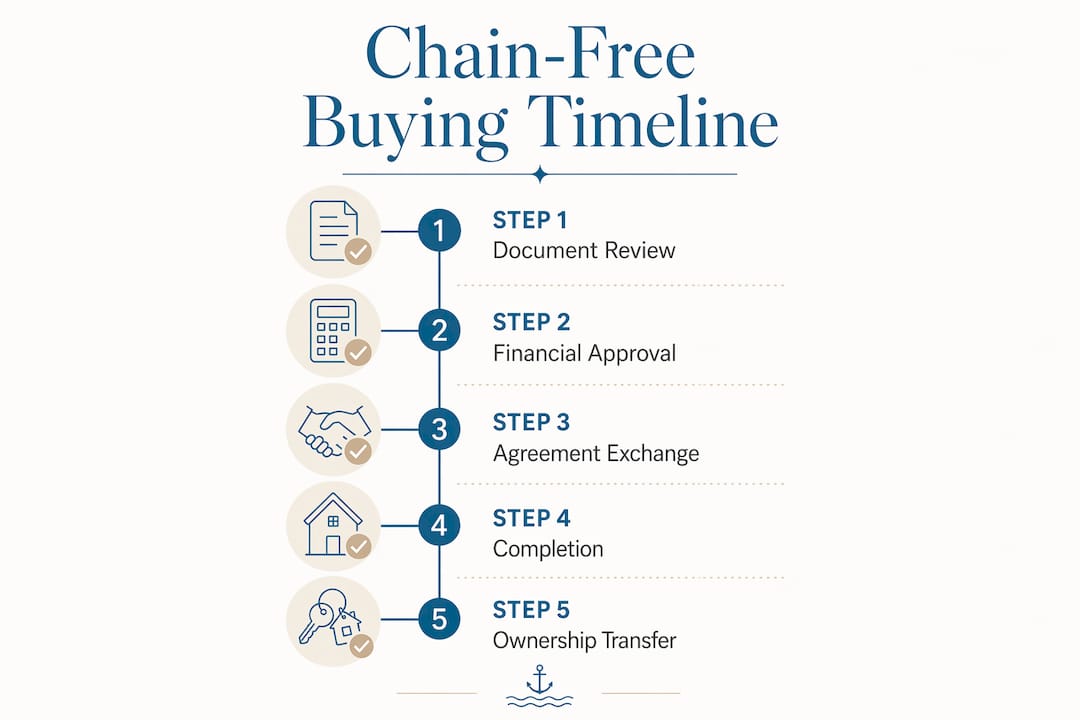
The steps you skip are significant. There are no Land Registry searches, no title deed transfers, no mortgage valuations tied to land, and no waiting for a seller further up the chain to find their next home. The primary bottleneck in traditional chains is sellers waiting to secure their onward purchase. Mobile home transactions eliminate this entirely because only the structure changes hands.
The mobile home buying process does still involve due diligence, even without conveyancing in the traditional sense. A specialist inspection of the structure is strongly advised. You should also verify the title to confirm no outstanding debts are attached to the home, and obtain park management approval to occupy the pitch.
- Agree a price with the seller
- Commission a specialist structural inspection of the home
- Conduct a title search to check for any debts secured against the structure
- Review the pitch agreement and site rules thoroughly
- Obtain park management approval to occupy
- Complete the transfer of ownership documentation
- Pay any applicable stamp duty or fees (rules vary by jurisdiction)
Pro Tip: Ask the park management for the site licence expiry date before you exchange. A licence nearing its end can affect your security of tenure and the home’s resale value.
Conveyancing solicitor involvement is not mandatory for mobile home purchases, but many buyers choose specialist support. A solicitor familiar with park home law can review the pitch agreement, flag unusual clauses, and confirm the title is clean. The cost is modest compared to the protection it provides.
How do you finance a mobile home without a mortgage?
Traditional mortgages rarely apply to mobile homes. Lenders tie mortgage products to land and buildings registered with the Land Registry. Because mobile homes are chattel, they fall outside standard mortgage criteria. This is one area where the chain-free advantage meets a genuine complication.
The most common financing route is a chattel loan. These are secured against the structure itself, much as a car loan is secured against a vehicle. Chattel loans carry interest rates 1.5%–2.5% higher than traditional mortgages. That premium reflects the lender’s higher risk, since the asset depreciates rather than appreciates, and the security is a structure rather than land.
Mortgage professional Lee Dama notes that chattel financing friction can offset the chain-free speed advantage if paperwork is not managed correctly. Stringent underwriting applies, and any missing documentation, including compliance labels on the structure, can stall approval. The chain-free process is fast, but financing delays can close that gap if you are not prepared.
Owner financing, where the seller accepts staged payments directly, is another option that some buyers and sellers arrange privately. This bypasses lenders entirely and can be the fastest route of all, though it requires careful legal documentation to protect both parties.
Key financing considerations at a glance:
- Chattel loans are the standard route but carry higher interest rates than mortgages
- Traditional mortgages do not apply to homes classified as personal property
- Owner financing is possible but requires robust legal agreements
- Missing compliance documentation on the structure can delay or block loan approval
- Specialist lenders with park home experience process applications more efficiently
For buyers considering the financial benefits of mobile home ownership, understanding the financing landscape before you start searching saves significant time and frustration.
What other risks should buyers consider?
The absence of a property chain does not mean the absence of risk. Several financial and legal considerations sit outside the chain question entirely, and buyers who overlook them often face costly surprises after completion.
Site fees are the most immediate ongoing cost. Park home owners typically pay monthly pitch fees of £150–£300, and these increase annually. When you sell, site owners take commission of up to 10% on the resale price. That commission is a unique feature of park home ownership with no equivalent in traditional property sales.
Depreciation is the other major financial reality. Mobile homes do not appreciate in value the way bricks-and-mortar properties typically do. Older homes depreciate, and the rate accelerates as the structure ages. This affects both your long-term financial position and your ability to secure financing in the future.
Expert John Martin advises that buyers should review pitch fees and future obligations thoroughly before signing anything. The pitch agreement is the document that governs your daily life on the park, and its terms matter as much as the purchase price.
Additional risks worth checking before you commit:
- Age restrictions on the park (many residential parks are adults-only or over-50s)
- Site licence expiry date and renewal prospects
- Compliance labels on the structure (required for certain financing programmes)
- Condition of utilities connections and any shared infrastructure
- Restrictions on subletting or holiday use
Understanding mobile home running costs in full before purchase gives you a realistic picture of what ownership actually costs month to month.
Key takeaways
Mobile homes involve no property chain because they are classified as personal property, not real estate, making the buying process faster and simpler than traditional house purchases.
| Point | Details |
|---|---|
| Chattel classification removes chains | Mobile homes are personal property, so no Land Registry deed transfer occurs and no chain can form. |
| Purchase speed is significantly faster | Cash purchases close in 1–2 weeks; financed purchases in 4–8 weeks, far quicker than standard property sales. |
| Financing differs from mortgages | Chattel loans apply instead of mortgages, with interest rates 1.5%–2.5% higher and stricter underwriting. |
| Due diligence remains essential | Inspect the structure, verify the title, and review the pitch agreement before committing to any purchase. |
| Ongoing costs affect long-term value | Monthly pitch fees of £150–£300 and resale commissions of up to 10% must factor into your financial planning. |
My honest view on buying mobile homes without chains
I have spoken with enough buyers over the years to know that “no chain” is the phrase that makes people relax too quickly. They hear it and assume the process is risk-free. It is not. It is simply a different set of risks, and those risks are less visible than the ones in a traditional sale.
The speed is real. Completing in a matter of weeks rather than months is genuinely life-changing for buyers who have been burned by collapsed chains before. But conveyancing manager Mike Willson is right when he warns that skipping specialist advice can jeopardise your investment. The pitch agreement is not a formality. It is the document that defines your rights on that park for as long as you own the home.
What I find buyers consistently underestimate is the depreciation question. A mobile home is not a wealth-building asset in the way a house can be. It is a lifestyle asset. If you approach it as such, you will make far better decisions about price, financing, and location. The buyers who are happiest are those who bought for the quality of life, not the capital return.
The chain-free process is a genuine advantage. Use it to move quickly and decisively. But spend the time you save on thorough due diligence, not on skipping steps.
— Ludo
Chain-free mobile homes in the Vendée: what Caravansinfrance offers
Caravansinfrance specialises in pre-owned mobile homes at Camping Les Prairies du Lac in the Vendée region of France. Every home is ready to move into, with no chain, no conveyancing delays, and no hidden fees to navigate.

The buying process is transparent and straightforward. You choose your home, review the pitch agreement, and complete the transfer without the months of uncertainty that traditional property purchases bring. Homes at the site benefit from a four-star setting, heated pools, and a warm coastal microclimate that makes every season feel like a good reason to be there. Browse the available homes in Vendée and see how quickly you could be settled into your own place in the sun. Additional listings are available at Caravansinfrance homes for buyers who want to compare options before deciding.
FAQ
Why is there no property chain with a mobile home?
Mobile homes are classified as personal property (chattel), not real estate, so no Land Registry deed transfer occurs. Without a deed-based transaction, no chain can form between buyers and sellers.
Do you need a solicitor to buy a mobile home?
Solicitor involvement is not legally required, but specialist legal support is strongly recommended. A park home solicitor can review the pitch agreement and title to protect your investment.
How long does a mobile home purchase take without a chain?
Cash purchases typically complete within 1–2 weeks. Financed purchases, using chattel loans, usually take 4–8 weeks depending on lender underwriting.
Can you get a mortgage on a mobile home?
Traditional mortgages do not apply to mobile homes classified as chattel. Buyers use chattel loans instead, which carry interest rates 1.5%–2.5% higher than standard mortgage rates.
What ongoing costs should mobile home buyers expect?
Monthly pitch fees typically range from £150–£300, and site owners charge commission of up to 10% on the resale price. These costs are unique to park home ownership and must factor into your long-term budget.