
Mobile home insurance basics: a family guide
Discover mobile home insurance basics for families. Learn how to protect your home and belongings before buying. Get informed today!
Mobile home insurance basics: a family guide
Mobile home insurance is a specialised policy designed to protect families’ factory-built homes, personal belongings, and financial liability from damage or loss. Known in the insurance industry as an HO-7 policy, it differs from standard homeowners insurance because it accounts for the unique structural characteristics of manufactured and mobile homes. If your family is considering life on a campsite or purchasing a mobile home outright, understanding mobile home insurance basics for families is the single most important step before you sign anything.
What does mobile home insurance cover for families?
Mobile home insurance for families covers four core areas: the dwelling structure, personal property, personal liability, and loss of use. Each area addresses a different risk your family faces as a mobile home owner.

Dwelling coverage
Dwelling coverage pays to repair or rebuild your home’s physical structure after damage from covered events such as fire, windstorm, hail, or vandalism. HO-7 policies are the industry standard for mobile and manufactured homes, and they account for structural vulnerabilities that a standard HO-3 homeowners policy does not. This matters because mobile homes are built differently from site-built houses, and their frames, roofing materials, and anchoring systems carry different risk profiles.
Personal property protection
Personal property coverage protects the contents inside your home, from furniture and electronics to clothing and kitchen appliances. Most basic mobile home coverage extends this protection even when belongings are temporarily outside the home, such as items stored in an outdoor shed. Families with children accumulate a surprising volume of possessions quickly, so setting your personal property limit realistically is worth the extra thought.
Here is what a standard family mobile home policy typically covers and excludes:
- Covered: Fire and smoke damage, windstorm and hail, theft, vandalism, water damage from burst pipes, falling objects
- Covered: Personal liability if a guest is injured on your property
- Covered: Loss of use, meaning temporary accommodation costs if your home becomes uninhabitable
- Excluded: Flood damage (requires a separate flood insurance policy)
- Excluded: Earthquake damage (requires a separate endorsement)
- Excluded: Damage during transport to the site, unless you purchase a specific transit insurance endorsement
Pro Tip: If you plan to move your mobile home to a new location, contact your insurer before the move. Standard policies do not cover transit damage, and arranging a transit endorsement in advance can save your family a very costly claim.
Liability and medical payments
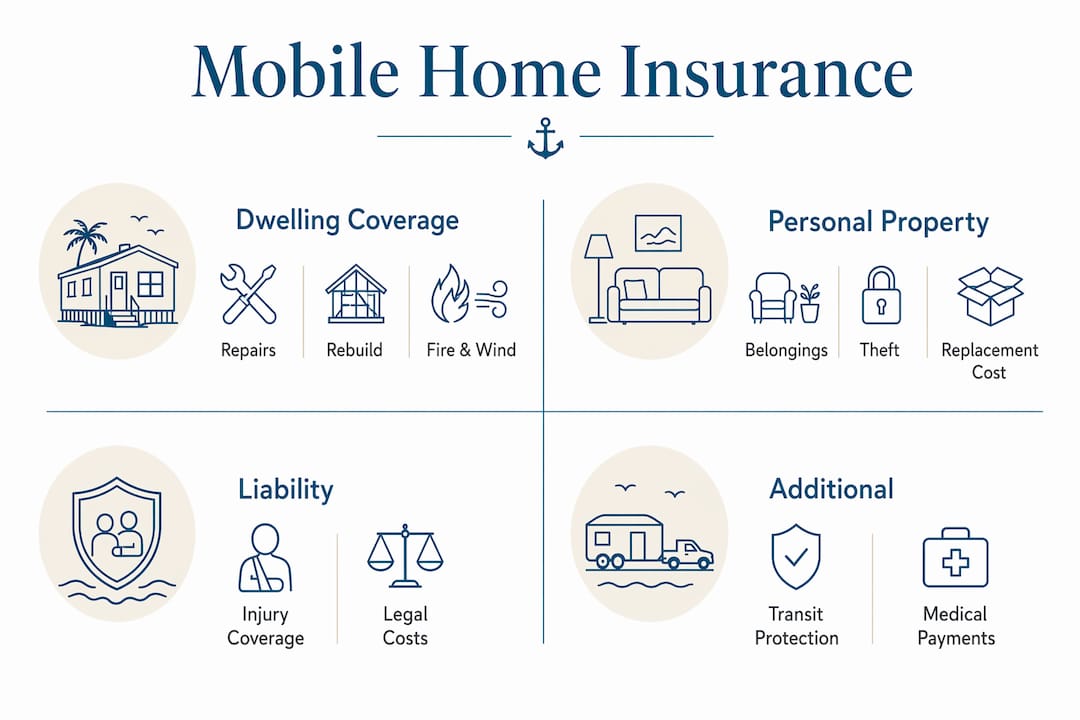
Personal liability coverage protects your family financially if someone is injured on your property and pursues legal action. It covers legal fees, court costs, and any settlement up to your policy limit. Medical payments coverage handles smaller, immediate medical costs for guests injured on your property, regardless of fault.
How much does mobile home insurance cost?
The average annual cost for mobile and manufactured home insurance ranges from $700 to $2,000 per year. That range is wide because several factors pull the premium in different directions.
The key pricing factors are:
- Age of the home. Older mobile homes cost more to insure because their materials and construction standards predate modern safety codes. A home built before 1976, when the US Department of Housing and Urban Development introduced federal construction standards, typically attracts higher premiums.
- Location. Homes in areas prone to hurricanes, tornadoes, or flooding carry higher risk. Insurers price that risk directly into your premium.
- Coverage limits. The higher the dwelling and personal property limits you choose, the higher your premium. Replacement costs for mobile homes range from $50,000 to $150,000, so setting your dwelling limit at replacement value rather than market value is the safer approach.
- Deductible level. Choosing a higher deductible reduces your annual premium. Families with a financial cushion often find this trade-off worthwhile.
- Claims history. A history of previous claims signals higher risk to insurers and raises your premium accordingly.
Compared with traditional homeowners insurance, mobile home premiums are often lower in absolute terms. However, premiums can be higher relative to the home’s value, because insurers perceive manufactured homes as carrying greater structural risk. That distinction matters when you are budgeting for ownership costs.
How to reduce your premium
Qualifying for discounts based on age, home condition, or residence in an approved mobile home community can reduce your annual premium meaningfully. Fitting smoke detectors, deadbolt locks, and storm shutters also signals lower risk to insurers. Bundling your mobile home policy with a car insurance policy from the same provider frequently unlocks a multi-policy discount.
Why does choosing the right policy matter for family security?
The right policy protects your family from financial loss that could otherwise take years to recover from. The wrong policy leaves gaps that only become visible at the worst possible moment.
Replacement cost versus actual cash value
The most consequential choice in any family mobile home policy is whether your personal property is covered at replacement cost or actual cash value. Actual cash value pays out what your belongings were worth at the time of the claim, after depreciation. A five-year-old laptop worth £800 new might be valued at £200 under actual cash value. Replacement cost endorsements pay the full cost to replace the item with a new equivalent, without any depreciation deduction. For families with children and a home full of everyday essentials, replacement cost coverage is the more protective option.
Scheduled personal property endorsements
Standard policies place low caps on high-value items such as jewellery, artwork, and collectibles. A scheduled personal property endorsement lists specific valuable items individually and insures each one at its agreed value. If your family owns items that exceed the standard policy limits, this endorsement closes that gap directly.
Pro Tip: Create a home inventory list with photos and receipts for your most valuable possessions. Store it securely in a cloud service or email it to yourself. This makes any future claim faster and far less stressful.
Additional coverage worth considering
Beyond the standard HO-7 structure, families should consider:
- Transit insurance if the home will ever be relocated
- Alternative living expenses cover if your home becomes uninhabitable after a covered event
- Flood insurance through a separate policy, particularly if your home sits in a low-lying area
What practical steps help families get the right cover?
Getting the right cover starts with knowing what you own and what it would cost to replace. These steps make the process straightforward.
- Assess your home’s value accurately. Get a professional valuation or use the insurer’s replacement cost estimator. Underinsuring your dwelling is one of the most common and costly mistakes families make.
- List your possessions. Walk through every room and note high-value items. This list becomes the basis for your personal property limit and any scheduled endorsements you need.
- Work with an agent who specialises in mobile home policies. Not every insurance agent is familiar with HO-7 policies. An agent with direct experience in manufactured home insurance will spot coverage gaps that a generalist might miss.
- Compare at least three quotes. Premiums for identical coverage can vary considerably between insurers. Comparing quotes takes an hour and can save your family hundreds of pounds each year.
- Review your policy regularly. Families grow, possessions accumulate, and home values change. A policy that was adequate three years ago may leave you underinsured today. An annual review keeps your cover aligned with your actual circumstances.
- Keep your documentation organised. Store your policy documents, home inventory, and receipts in one place. When a claim arises, having everything ready speeds up the process considerably.
Key takeaways
Understanding mobile home insurance basics for families means knowing that an HO-7 policy covers your dwelling, possessions, and liability, and that choosing replacement cost cover and the right endorsements prevents costly gaps.
| Point | Details |
|---|---|
| HO-7 is the standard policy | Mobile and manufactured homes require an HO-7 policy, not a standard HO-3 homeowners policy. |
| Annual costs vary widely | Premiums typically range from $700 to $2,000 per year depending on age, location, and cover limits. |
| Replacement cost beats actual cash value | Replacement cost endorsements pay full item value without depreciation, protecting families from shortfalls. |
| Transit damage is excluded by default | Standard policies do not cover damage during a move; a separate transit endorsement is required. |
| Regular policy reviews prevent under-insurance | Reviewing cover annually keeps limits aligned with your home’s current value and your family’s possessions. |
My honest view on mobile home insurance as a family investment
The most common mistake I see families make is treating insurance as a box to tick rather than a genuine financial safety net. They pick the cheapest policy, accept the default limits, and assume they are covered. They are not, not fully.
The gap between actual cash value and replacement cost is the one that stings most. A family loses their home to a fire and discovers their payout covers perhaps half of what it costs to replace their belongings. That is not a theoretical risk. It is a predictable outcome of choosing the wrong policy option, and it is entirely avoidable.
The second thing families consistently overlook is the transit exclusion. Most buyers assume their home is covered from the moment they purchase it, including during delivery. It is not. If your mobile home is damaged in transit and you have no endorsement in place, you bear that cost entirely. Asking your insurer about transit cover before the home moves is a five-minute conversation that can save you tens of thousands.
My advice is simple. Spend an extra hour with your insurer going through every line of your policy. Ask specifically about replacement cost, scheduled endorsements, and transit cover. A well-chosen family mobile home policy is not expensive relative to what it protects. The cost of getting it wrong is far higher.
— Ludo
Family-friendly mobile homes in France: what Caravansinfrance offers
If you are weighing up mobile home ownership as a family, the practical and financial picture becomes much clearer when you can see exactly what you are buying.
Caravansinfrance specialises in pre-owned mobile homes in the Vendée region of France, all situated at Camping Les Prairies du Lac. The homes are ready to move into, with no hidden fees or property taxes to navigate. Families who purchase through Caravansinfrance gain access to heated pools, community activities, and a warm coastal microclimate that makes every visit feel like a proper break. Browse the current selection of family mobile homes and see which one fits your plans. If you have questions about ownership costs, insurance considerations, or the buying process, the team is ready to help you find the right fit.
FAQ
What is an HO-7 policy?
An HO-7 policy is the standard insurance product for mobile and manufactured homes. It covers the dwelling structure, personal belongings, liability, and loss of use, and it accounts for the structural differences between factory-built and site-built homes.
Does mobile home insurance cover flood damage?
Standard mobile home insurance policies do not cover flood damage. Families in flood-prone areas need to purchase a separate flood insurance policy to protect their home and belongings.
Is mobile home insurance more expensive than regular homeowners insurance?
Mobile home insurance premiums are often lower in absolute terms but can be higher relative to the home’s value. Insurers price in the perceived structural risk of manufactured homes, which can push the rate up proportionally.
What does transit insurance cover for mobile homes?
Transit insurance covers damage to your mobile home while it is being transported to a new location. Standard HO-7 policies exclude this risk, so a separate endorsement or policy is required before any move takes place.
How can families lower their mobile home insurance premium?
Families can reduce premiums by fitting safety devices such as smoke detectors and deadbolts, choosing a higher deductible, residing in an approved mobile home community, and bundling their home policy with another insurance product from the same provider.