
Living permanently in a mobile home in France: your guide
Discover how to achieve mobile home permanent living in France. Learn the legal requirements and avoid costly mistakes for your residency.
Living permanently in a mobile home in France: your guide
You can live permanently in a mobile home in France, but only under specific legal conditions that most guides gloss over. The home must be formally classified as a résidence démontable (dismountable residence) under the ALUR law, sited on constructible land with planning authorisation, and serve as your primary residence for at least eight months per year. A standard recreational mobile home in a campsite does not qualify. The distinction matters enormously in practice, and getting it wrong can mean a forced removal notice.
Here is what you need to know before you commit:
- A standard recreational mobile home is legally defined as a vehicle for temporary or seasonal leisure use, not permanent habitation.
- Permanent residency requires the résidence démontable classification, planning permission, and constructible land zoning.
- Removing wheels or fixing the home to the ground changes its legal status entirely, triggering building permit requirements.
- Tolerance by a local mayor is not the same as legal permission. It can be withdrawn at any time.
- The safest route to compliant long-term living is a residential leisure park (parc résidentiel de loisirs) with a clear plot contract.
What French law actually says about mobile home permanent living in France
French law defines a recreational mobile home as a habitable land vehicle intended for temporary or seasonal leisure use. It must retain its wheels, tow bar, and traction equipment to keep its mobile status. The Highway Code prohibits it from moving independently on public roads, so it travels as a specialist convoi exceptionnel.
The ALUR law of 2014, codified in Articles L.444-1 and R.444-1 of the urban planning code, introduced the résidence démontable category. This is the legal bridge between a leisure vehicle and a permanent home. To qualify, the installation must sit on land zoned constructible under the local urban planning document (PLU), receive formal planning authorisation, connect to utilities or provide an approved autonomous solution, and be occupied as the resident’s primary home for a major part of the year.
Legal advisors are clear on this point: tolerance by local authorities is not legalisation. A commune can permit a mobile home to sit on private land for years, then issue a removal order the moment the political wind changes or the PLU is revised. Residents without formal permits have no legal protection against this.
The surface area threshold also matters. French law caps a recreational mobile home at 40m² before it is reclassified as a light leisure dwelling (habitation légère de loisirs, or HLL), which carries its own stricter rules. Below 40m², a planning declaration suffices for the résidence démontable route; above it, a full planning permit is required.
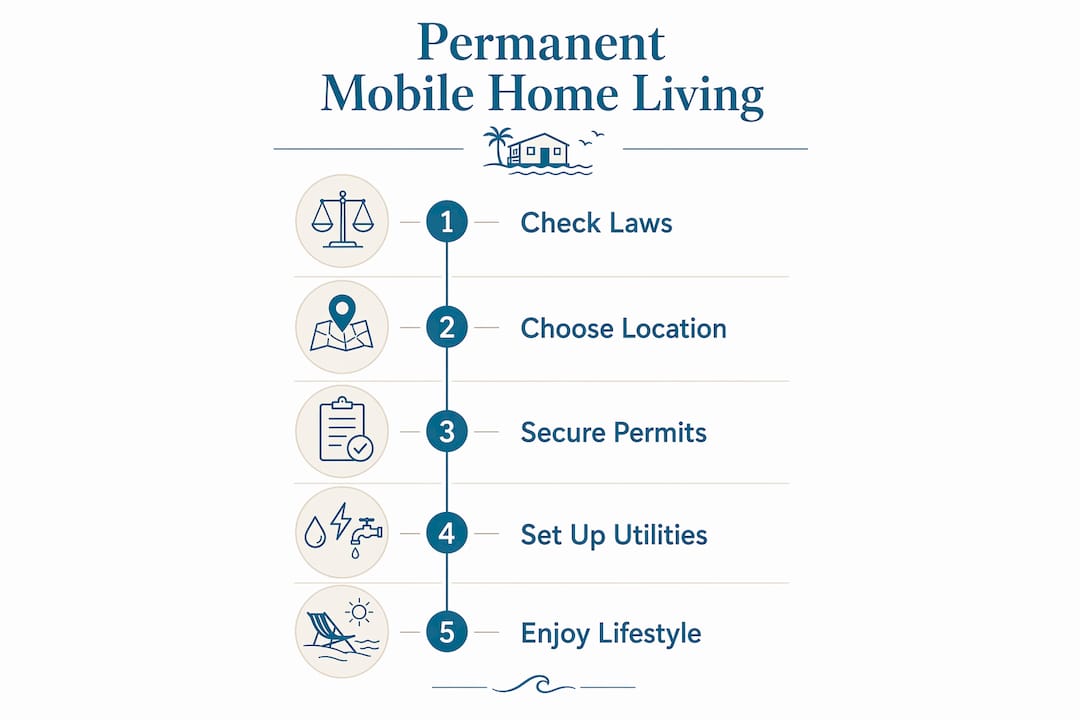
- Confirm the land is zoned constructible in the local PLU.
- Check for specific municipal restrictions: height limits, setbacks, aesthetic requirements.
- Submit the correct planning authorisation (declaration or full permit, depending on floor area).
- Retain all means of mobility unless you are proceeding as a fixed construction with a building permit.
- Obtain a rescrit fiscal (written tax ruling) from the local tax authority before installation.
Pro Tip: Request a certificat d’urbanisme opérationnel from the mairie before you buy. This formal document gives you a written answer on whether your specific plot and project are viable, and it protects you if the rules change shortly after.
Where can you legally place a mobile home for long-term living?
The placement rules are stricter than many buyers expect. A standard recreational mobile home with its wheels and tow bar intact cannot be placed in a private garden at all. It is only permitted in three types of location:
- Residential leisure parks (parcs résidentiels de loisirs): the most secure option for long-term living, with recognised domiciliation possible where the park holds a permis d’aménager.
- Holiday villages classified as accommodation (villages de vacances en hébergement): permitted, but check whether permanent residency is allowed under the park’s own regulations.
- Authorised campsites: permitted, though most campsites limit stays to a maximum of two consecutive years to prevent sites becoming permanent residential settlements.
On private land, a mobile home may park without formality for less than three months per year, provided it is used for leisure, not habitation. Beyond that, planning authorisation is required. Local risk prevention plans (PPRI) can block installation entirely in flood-prone areas or within the protected perimeter of a listed monument, regardless of zoning.
When you buy a mobile home in a park, you almost always own the home but rent the plot. The plot contract governs your right to stay, the annual fees, renewal terms, and your ability to resell. Always consult the local mairie and read the PLU before committing to any site.

Tax and cost implications of living full-time in a mobile home
The tax picture depends almost entirely on whether your home retains its mobility status. A recreational mobile home that keeps its wheels and is used on a temporary or seasonal basis is exempt from taxe foncière and taxe d’habitation. That exemption disappears the moment the home is fixed to the ground or loses its means of mobility.
Once fixed, the home becomes a construction subject to the PLU, and the taxe d’aménagement applies as soon as planning authorisation is granted. Its amount depends on the floor area and the local communal rate. If the home is used as a secondary residence rather than a primary one, taxe d’habitation may also apply.
- Recreational mobile homes in parks: exempt from property taxes, but subject to tourist tax (typically a few euros per day) and annual plot rental fees.
- Fixed or reclassified homes (HLL): subject to taxe d’aménagement and potentially taxe foncière.
- Secondary residence use: taxe d’habitation may apply even where the primary exemption does not.
- Annual park costs: plot rent, water, electricity, gas, and site maintenance charges vary by park and region.
Pro Tip: Before installation, request a rescrit fiscal in writing from the service des impôts fonciers. This gives you a formal, binding statement of how your specific situation will be taxed, protecting you from retrospective reassessment.
Practical lifestyle considerations for permanent mobile home residents
Living full-time in a mobile home in France is genuinely enjoyable when the legal foundations are solid. The social life in a well-run residential leisure park can be warm and community-minded, with shared facilities, seasonal events, and neighbours who have made the same lifestyle choice. Rural parks in regions like the Vendée offer a slower pace, easy access to markets and beaches, and a real sense of belonging.

Utilities are generally straightforward in established parks. Water, electricity, and sewage connections are built into the infrastructure, and waste collection follows the commune’s standard schedule. On private land, you may need to arrange an autonomous sanitation solution, which must be declared and approved as part of your planning application.
For UK nationals post-Brexit, the administrative picture requires careful attention. You will need a long-stay visa or a carte de séjour to live in France for more than 90 days in any 180-day period. Healthcare access through the French system (CPAM) requires registration, and your address must be formally recognised by the mairie for administrative domiciliation. A mobile home in a park with a permis d’aménager gives you a recognised address; a tolerated installation on private land may not.
- Confirm the mairie will register your address before signing any purchase contract.
- Read the plot contract carefully: check age limits on homes, renewal terms, resale conditions, and fee escalation clauses.
- Arrange home insurance before moving in. Insurers often require proof of planning compliance.
- Register with CPAM and your local GP as soon as your address is confirmed.
- Do not assume that years of tolerance equal a legal right to stay. A change of mayor or a PLU revision can trigger a compliance notice with no warning.
You can read more about what life on the campsite looks like day to day, from community rhythms to practical routines.
How Caravansinfrance makes permanent mobile home living straightforward in Vendée
Caravansinfrance.com offers a practical, transparent route to mobile home living in France for UK buyers who want to skip the legal maze. All homes are pre-owned and sited at Camping Les Prairies du Lac in the Vendée, a four-star site in Apremont with heated pools, community activities, and a warm coastal microclimate that draws residents back year after year.
The Caravansinfrance approach is built around clarity. Buyers know exactly what they are purchasing, what the plot arrangements involve, and what the ongoing costs look like. There are no hidden fees, no property taxes on the mobile home itself, and no complex conveyancing. You buy the home, the site handles the rest.
The Vendée location adds genuine lifestyle value. The region sits close to the Atlantic coast, with the Puy du Fou theme park, weekly markets, and miles of cycling trails within easy reach. You can explore things to see and do in Vendée to get a feel for what permanent life there looks like beyond the park gates.
Key reasons buyers choose Caravansinfrance:
- Turnkey purchase: ready-to-move-in homes with no renovation surprises.
- Transparent contracts: clear plot rental terms with no hidden clauses.
- No property taxes: homes retain mobile status, keeping tax liability low.
- Full amenities: heated pool, community spaces, and on-site support.
- Legal clarity: sited on an authorised campsite, so placement is compliant from day one.
Browse the current available mobile homes to see what is on the market in Vendée right now.
Key takeaways
Permanent mobile home living in France is legal only when the home is classified as a dismountable residence on constructible land with planning authorisation, or when sited in an authorised residential leisure park under a clear plot contract.
| Point | Details |
|---|---|
| Legal classification is everything | Only a résidence démontable with planning permission allows permanent primary residency on private land. |
| Eight months per year threshold | The ALUR law requires occupation as your primary residence for at least eight months per year to qualify. |
| Mobility status protects from tax | Homes retaining wheels and tow equipment are exempt from taxe foncière and taxe d’habitation. |
| Tolerance is not a legal right | Mayors can withdraw tacit permission at any time; only formal authorisation gives lasting security. |
| Residential leisure parks are the safest route | Parks with a permis d’aménager provide recognised domiciliation, utility connections, and legal clarity. |