
Mobile home resale value in France: 2026 guide for UK buyers
Discover the mobile home resale value guide for France. Understand depreciation trends and make informed buying decisions to avoid surprises.
Mobile home resale value in France: 2026 guide for UK buyers
How does mobile home resale value work in France?
Mobile homes in France follow a predictable depreciation curve, and knowing the numbers before you buy or sell can save you from a costly surprise. According to industry depreciation data, a mobile home loses a significant portion of its value in the first year, followed by substantial annual depreciation thereafter. By year ten, the value is considerably lower than the original purchase price.
That steep early drop reflects something fundamental about how these assets are classified. Under French law, a mobile home is a bien meuble, a moveable asset, not real estate. There is no notary involvement, no mutation tax, and no mandatory registration as you would expect with a house purchase. That distinction shapes everything from how you price the unit to how you transfer ownership.
Key depreciation benchmarks at a glance:
- Year 1: loses about 30% of value
- Year 2: loses roughly 15%
- Year 3: loses around 10%
- Year 4 and each year after: depreciates by approximately 7% annually
- After 20 years: market value very low for most models
Brand and maintenance make a real difference to where your unit lands within those bands. French manufacturers such as IRM and O’Hara tend to retain better resale value than imported models, largely because of build quality and the availability of spare parts in the French market.
What factors influence the resale price of a mobile home in France?
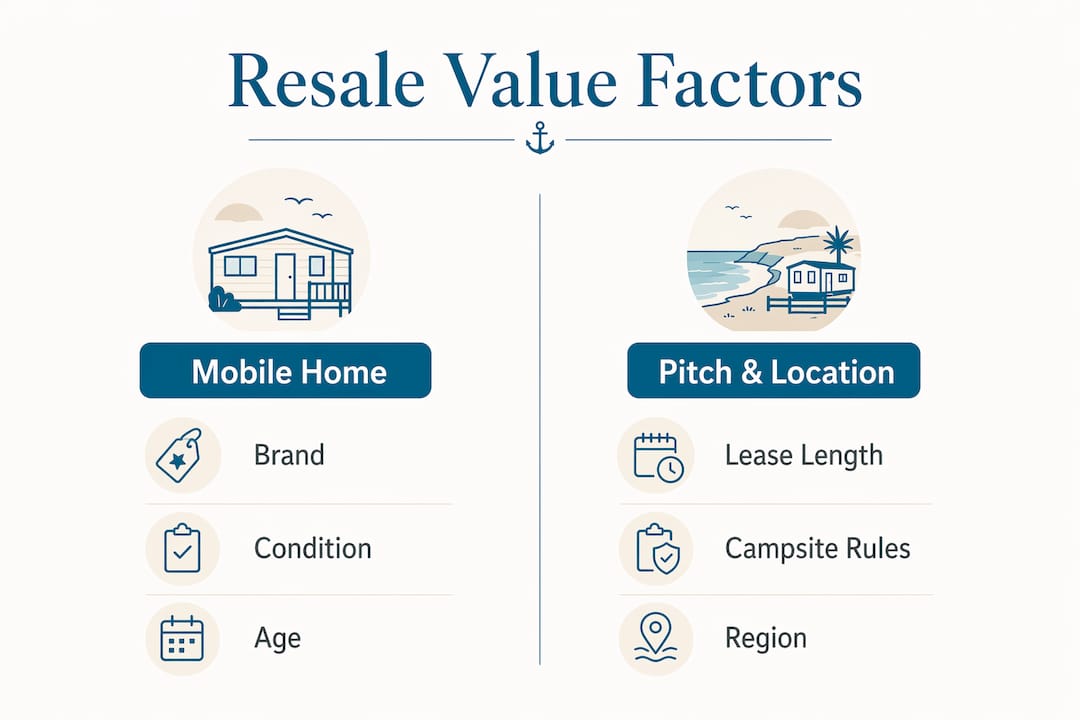
Age and physical condition are the starting point for any valuation, but they are far from the whole story. The lease agreement tied to the pitch is often what determines whether a mobile home sells at all.
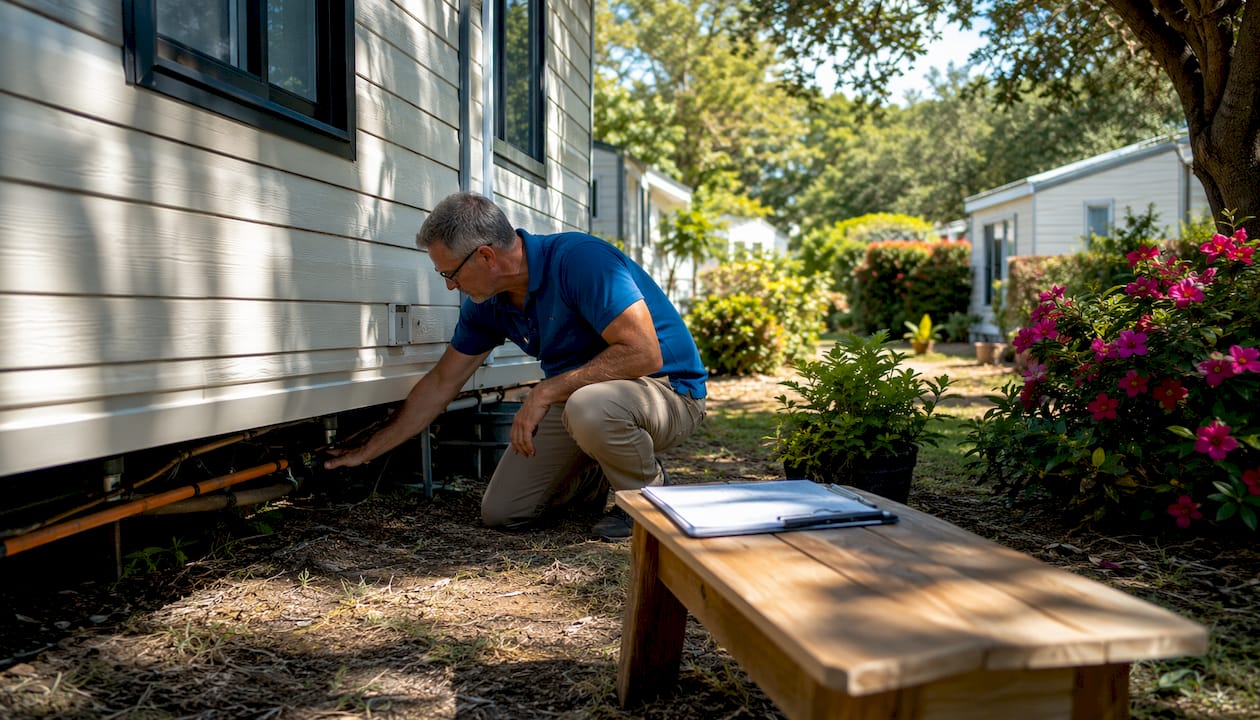
- Age and condition: A well-maintained unit with documented service history commands a noticeably higher price than a neglected equivalent. Buyers inspect floors for soft spots, roofs for water ingress, and windows for seal integrity.
- Lease transferability: If the campsite manager refuses to transfer the pitch contract to a new buyer, the mobile home loses virtually all market value. The unit becomes a moveable object with nowhere to go.
- Location and campsite quality: A pitch at a four or five-star site, particularly near the Atlantic coast or the Vendée, can add a meaningful premium to the assessed value compared with a standard inland plot.
- Brand reputation: IRM, O’Hara, and Louisiane are regarded as dependable choices in the French market, with a slower depreciation curve than lesser-known or imported brands.
- Campsite age policies: Many sites impose a maximum age limit, often 15–20 years, after which they can require removal. A mobile home close to that threshold is far harder to sell on-site.
- Right-to-reside clauses: Some pitch contracts include clauses giving the campsite a right of first refusal on any resale, or require formal written approval before a transfer can proceed.
- Pitch fees and renewal terms: High annual fees or short remaining lease terms reduce what a buyer is willing to pay, since ongoing costs directly affect the investment’s appeal.
The relationship between the mobile home and its pitch is best understood as two separate but inseparable transactions. You own the unit; you rent the ground beneath it. A buyer who cannot secure the pitch has bought nothing of practical use.
How do you value a mobile home in France?
There is no official argus (price guide) for mobile homes in France the way there is for cars, but the market has developed a widely used depreciation table that professionals and constructors share as a benchmark. The starting point is always the original purchase price, adjusted by the residual value percentage for the unit’s age.
A practical three-step approach:
- Step 1 — Calculate the base value. Take the new purchase price and apply the relevant residual percentage from the depreciation table. A mobile home bought new at €40,000 is worth approximately €18,400 after five years, based on a 46% residual value.
- Step 2 — Adjust for condition and extras. A covered terrace, reverse-cycle air conditioning, or a recently replaced roof can justify adding 5–20% above the base figure. Be realistic: a terrace does not double the price.
- Step 3 — Apply a downward adjustment for risks. If the campsite age limit leaves only two or three years of permitted occupation, or if there are visible structural defects, reduce the price accordingly. This is often the step sellers skip, and it leads to units sitting unsold.
Professional appraisals go further, combining a physical inspection of the chassis, plumbing, and electrics with a review of recent comparable sales in the same campsite or region. Comparative market analysis, looking at what similar units on similar pitches have actually sold for, is the most reliable cross-check. The website cotedumobilhome.com offers a free online calculator as a useful starting point, though it should be treated as a guide rather than a definitive valuation.
Pro Tip: Always verify the remaining permitted years on the pitch contract before agreeing a price. A mobile home with two years left before mandatory removal is worth a fraction of an equivalent unit with ten years remaining, regardless of its physical condition.

How can you maximise the resale value of your mobile home?
Preparation makes a measurable difference to both the sale price and the speed of the transaction. The buyers most likely to pay a fair price are also the most likely to walk away from a disorganised seller.
- Gather complete documentation. Purchase invoices, maintenance records, and the pitch lease contract reassure buyers and remove the most common grounds for negotiating the price down.
- Address maintenance before listing. Fixing a leaking roof seal or replacing worn flooring costs far less than the price reduction a buyer will demand when they spot the problem.
- Secure written campsite approval early. Approach the campsite manager before you find a buyer, not after. Some sites have a right of first refusal; discovering this late can collapse a sale.
- Modernise selectively. A new kitchen worktop or updated bathroom fittings can lift appeal without requiring significant outlay. Buyers respond to a unit that feels cared for.
- Time the sale carefully. Mobile homes approaching the 15–20 year age threshold face sharply reduced buyer interest, because purchasers factor in imminent removal costs. Selling at year 12 or 13 preserves far more value than waiting until the campsite enforces its age limit.
Pro Tip: Spring and early summer are the strongest selling seasons in French campsites. Listing in february or march, before the peak holiday enquiries begin, puts you in front of buyers who are actively planning and ready to commit.
What UK buyers and sellers need to know about the French mobile home market
The legal framework governing mobile home resale in France is genuinely different from anything UK buyers encounter at home, and understanding it protects you from the most common and costly mistakes.
Legal status and transaction process
A mobile home remains a moveable asset under French law for as long as it is transportable and not fixed to the ground by permanent foundations. The transaction uses a private sale agreement (acte sous seing privé) rather than a notarised deed. The seller provides the original purchase invoice or previous transfer document; both parties sign a sale contract describing the unit by brand, model, year, dimensions, and serial number. No stamp duty or mutation tax applies.
The pitch contract is the critical document
Since january 2026, French campsite managers are legally required to provide prospective occupants with a written information notice and the site’s internal regulations before any contract is signed. These documents must set out renewal and non-renewal conditions, including any age-related removal clauses. As a UK buyer, request these documents before you commit to anything.
Taxation
Capital gains on a mobile home fall under the French rules for moveable assets, not the property gains regime. In practice, resale rarely generates a taxable gain given the depreciation rates involved. If you have been letting the unit under a furnished rental arrangement, seek advice on the fiscal implications before selling.
Regional variations and typical timeframes
Coastal regions, particularly the Vendée, the Atlantic coast, and the Côte d’Azur, command higher prices than inland areas. The Vendée is especially popular with UK buyers for its mild climate, accessible beaches, and family-friendly campsites. Sales at well-regarded sites in these regions tend to complete more quickly than those in less sought-after locations. Expect a typical sale process of four to twelve weeks once a buyer is found, with the main variable being the time required to obtain formal campsite approval for the transfer.
Market context
The secondhand mobile home market in France has been professionalising steadily, with park operators playing an increasing role in fleet renewal. This creates more predictable pricing for well-maintained units on attractive sites, since professional buyers assess value systematically rather than emotionally. For private sellers, this means that condition and documentation matter more than ever.
Caravansinfrance specialises in pre-owned mobile homes at Camping Les Prairies du Lac in the Vendée, a four-star site with heated pools and year-round community amenities. The ownership process is designed to be transparent from the outset, with no hidden fees and clear lease terms, which is precisely the kind of clarity that protects resale value over time.
Common pitfalls and red flags in mobile home resale transactions
The most expensive mistakes in mobile home resale are almost always avoidable with a little advance preparation.
- Assuming the pitch transfers automatically. It does not. The campsite must approve the new occupant separately, and some contracts give the site a right of first refusal or even a veto. Always get written confirmation before exchanging.
- Overlooking the age limit clause. A mobile home that looks excellent at 14 years old may be unlet table on its current pitch within 12 months. Check the site’s internal regulations, not just the seller’s word.
- Ignoring campsite commission charges. Some sites charge the seller a commission on resale, and others charge the buyer an entry fee. Both reduce the net proceeds or increase the buyer’s total cost. Read the pitch contract in full.
- Buying without a site inspection. A mobile home sold without an emplacement (pitch) is worth considerably less, because the buyer must arrange transport and find a new site willing to accept the unit, particularly if it is older.
- Accepting verbal assurances about lease renewal. Lease renewal is never guaranteed. If a seller tells you the contract “always gets renewed,” ask for that in writing from the campsite manager.
- Underestimating removal costs. If the campsite refuses to renew the pitch contract, the owner bears the cost of transporting the unit. For an older mobile home, those costs can exceed its remaining market value.
Key takeaways
Mobile home resale value in France depreciates predictably from the first year, but the pitch lease, campsite policies, and unit condition are what ultimately determine whether a sale succeeds and at what price.
| Point | Details |
|---|---|
| Depreciation is steep early | A mobile home loses about 30% of its value in the first year, then roughly 15% in year two, 10% in year three, and approximately 7% annually from year four onward. |
| The pitch lease drives value | If the campsite refuses to transfer the lease, the mobile home can lose all practical market value regardless of condition. |
| Age limits create a hidden deadline | Many French campsites enforce a 15–20 year maximum age, sharply reducing resale options as a unit approaches that threshold. |
| Documentation protects your price | Purchase invoices, maintenance records, and the pitch contract reassure buyers and reduce the scope for price negotiation. |
| Location adds a meaningful premium | A pitch at a coastal or four-star site can be worth up to 20% more than an equivalent unit on a standard inland plot. |
Ready to find a mobile home in France where the paperwork is straightforward and the lifestyle is everything you hoped for? Browse the available homes in Vendée at Caravansinfrance, or explore the full range of listings to find the right fit for your plans.