
Role of campsite as permanent address: 2026 guide
Discover the role of campsite as permanent address in 2026. Learn why campsites lack legal recognition and how it impacts your living plans.
Role of campsite as permanent address: 2026 guide
A campsite address is defined as a transient lodging location, not a legal residential address, and most government agencies do not accept it as a permanent domicile. This distinction matters enormously if you are considering long-term or permanent campsite living. The role of campsite as permanent address is more limited than many people realise, but the practical picture is richer and more nuanced than a flat legal “no” suggests. Understanding both sides gives you the clarity to plan your alternative living arrangements properly.
Why campsites are not accepted as permanent addresses
Most RV parks and campsites are not recognised as legal permanent addresses by state DMVs, insurance providers, or voter registration offices. The core reason is classification. Campsites sit in the “transient or temporary lodging” category under zoning and land use law, the same bracket as hotels and holiday parks. That classification blocks them from qualifying as residential addresses for official purposes.
The practical consequences are significant. Government agencies require a real, physical street address, not a P.O. box and not a campsite pitch number, for driving licences, vehicle registration, and voting rolls. If you attempt to register using a campsite address without a proper commercial mail forwarding arrangement, you risk accusations of voter registration fraud or licensing irregularities. These are not theoretical risks. They have resulted in real legal complications for long-term campers.
Zoning regulations add another layer of difficulty. Most campsite land is zoned for recreational use, not residential habitation. Local authorities enforce this distinction, and operators who advertise their sites as “permanent residency friendly” have no legal authority to grant that status. The address remains transient in the eyes of government agencies regardless of what the campsite brochure says.
There is also the question of tenant rights. Campground operators are typically classified as innkeepers rather than landlords under residential tenancy law. That means you do not enjoy the same protections as a conventional tenant. Eviction can happen quickly and without the formal process a landlord must follow. If you violate park rules or miss a payment, you may find yourself without a home and without legal recourse.

Pro Tip: Set up a commercial mail forwarding service with a real street address before you commit to campsite living. Services like these give you a legitimate domicile for government correspondence without requiring you to own or rent a conventional property.
The risks of relying solely on a campsite address include:
- Rejection of driving licence or vehicle registration applications
- Disqualification from voter registration rolls
- Denial of insurance cover tied to a residential address
- Vulnerability to swift eviction without tenant protections
- Potential legal scrutiny over domicile fraud
How 2026 legislation is reshaping long-term campground stays
Legislative attitudes toward long-term campsite living are shifting, though not as fast as many residents would like. Current regulations typically enforce a 180–183 day limit on stay duration at licensed campgrounds. That cap has long been the practical ceiling for anyone wanting to call a campsite home.
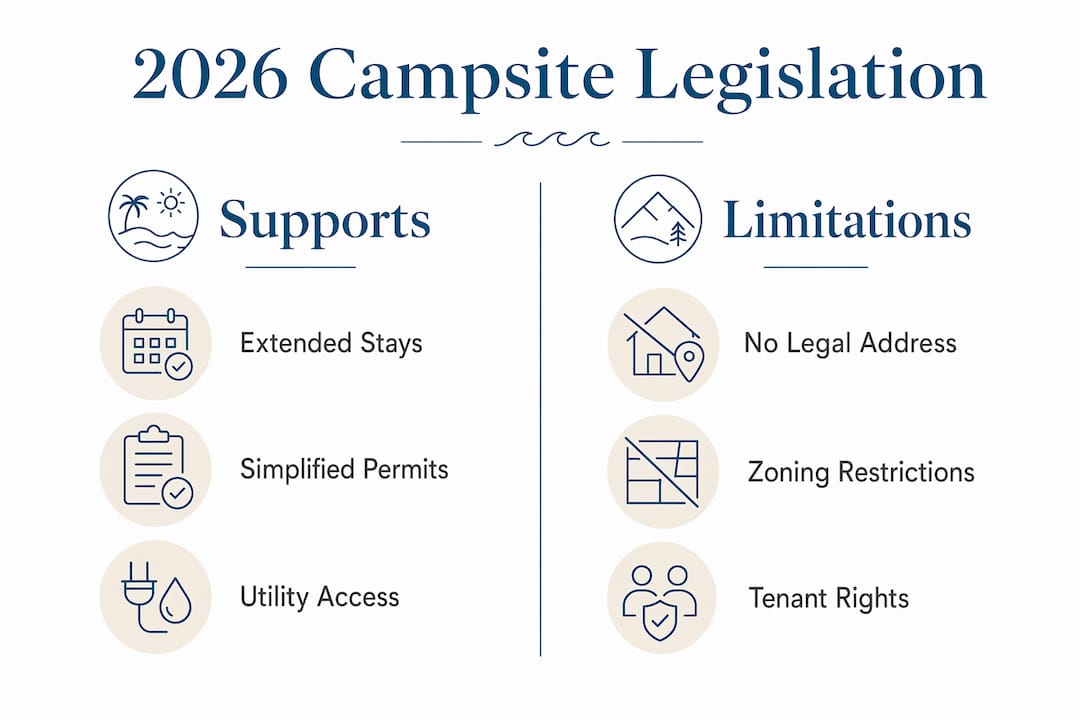
Michigan’s House Bill 5430 is one of the most discussed proposals in this space. It seeks to extend permitted stays beyond the standard six-month limit under specific conditions, responding directly to housing shortages and workforce accommodation needs in northern communities. Similar proposals are appearing in other states where affordable housing is scarce and campsite infrastructure is already in place.
The key points about these legislative changes are:
- Extended stays beyond 180 days are being considered in areas with documented housing shortages.
- Proposals typically require campsites to meet minimum infrastructure standards before longer stays are permitted.
- Legal recognition as a permanent residence for voting or licensing purposes remains mostly unchanged even where extended stays are approved.
- Operators must demonstrate adequate utilities, sanitation, and safety provision to qualify for extended-stay licences.
- These laws respond to economic pressure, not a philosophical shift in how governments classify campsite addresses.
The gap between “you can stay longer” and “this is your legal home” remains wide. Extended stay permissions ease the practical burden of campsite living without resolving the underlying legal status problem. Residents who benefit from these proposals still need a separate official domicile for government correspondence.
Statistic callout: Campsite supply grows at approximately 1% annually, while demand for long-term sites continues to rise. That gap creates a scarcity premium that pushes prices up and makes securing a good long-term pitch increasingly competitive.
How campsites support long-term residents in practice
The operational reality of modern campsites has changed considerably. Campsite operators are shifting focus toward long-term residents, using CRM tools and automated billing to build stable, community-oriented environments. This is not simply a hospitality trend. It reflects a genuine business calculation: long-term residents provide predictable revenue and reduce the operational churn of constant new arrivals.
Reception services play a central role in this shift. A well-run campsite reception does far more than check guests in and out. For permanent or long-term residents, reception staff manage parcel deliveries, coordinate maintenance requests, and act as the first point of contact for community concerns. This kind of consistent, attentive service is what separates a site that works for long-term living from one that merely tolerates it.
Infrastructure is the other decisive factor. Full utility hookups including water, sewer, and electricity, combined with reliable high-speed internet, are the baseline requirements for year-round habitation. Sites without these cannot realistically support permanent residents, regardless of how welcoming the management is. The growth in long-term campsite living is driven partly by remote work flexibility, and residents who work from their pitch need connectivity that matches what they would expect in a conventional home.
Pro Tip: When evaluating a campsite for long-term living, ask specifically about winter utility provision and internet speeds during peak season. Many sites reduce services outside summer months, which can make year-round living uncomfortable.
| Feature | Why it matters for long-term residents |
|---|---|
| Full utility hookups | Supports year-round habitation without reliance on temporary solutions |
| High-speed internet | Meets remote working and daily connectivity needs |
| CRM and automated billing | Reduces admin friction and builds trust between operator and resident |
| Dedicated reception services | Handles deliveries, maintenance, and community communication |
| Community activities | Builds social cohesion and improves quality of daily life on site |
For those exploring what life on the campsite genuinely looks like day to day, the amenities and community feel of a well-managed site can be genuinely impressive.
What does long-term campsite living actually cost?
Cost is where many people’s plans meet reality. Seasonal site costs have risen sharply, with some locations charging upwards of £8,000 per season plus electricity in 2026. Dynamic pricing compounds this. Peak season surges can push weekly rates well above the annual average, meaning the headline seasonal price understates the true annual outlay.
Zoning restrictions and limited supply growth of approximately 1% annually create a scarcity premium in desirable areas. Coastal and rural sites in popular regions are particularly affected. Affordable long-term pitches in attractive locations are becoming harder to secure and more expensive when you find them.
Beyond the pitch fee, residents typically face:
- Electricity charges billed separately from the site fee
- Storage fees for additional vehicles or equipment
- Maintenance contributions for shared facilities
- Mail forwarding service subscriptions for legal domicile purposes
- Potential costs for upgrading mobile home insulation or heating for winter use
Compared with conventional renting, long-term campsite living can appear cheaper at first glance. The full picture is more complex. When you add electricity, storage, mail forwarding, and the cost of maintaining a mobile home to a liveable standard year-round, the gap narrows considerably. Understanding your mobile home running costs before committing is the single most useful financial step you can take.
Key takeaways
A campsite address is legally classified as transient lodging in most jurisdictions, meaning it cannot replace a formal residential address for driving licences, voter registration, or insurance without a supplementary mail forwarding arrangement.
| Point | Details |
|---|---|
| Legal status is transient | Campsites are classified as temporary lodging, not residential addresses, by government agencies. |
| Mail forwarding is essential | A commercial mail forwarding service with a real street address is required for legal domicile purposes. |
| Legislation is evolving slowly | Proposals like Michigan HB 5430 extend stays but do not grant permanent address recognition. |
| Infrastructure defines viability | Full hookups and reliable internet are the baseline for year-round campsite living. |
| Costs are rising | Scarcity, dynamic pricing, and additional charges mean long-term campsite living is not automatically cheap. |
Why I think most people underestimate the legal gap
People who are drawn to alternative living arrangements often focus on the lifestyle and underestimate the legal architecture underneath it. I understand that impulse completely. The appeal of waking up with birdsong outside your window, no mortgage, and a community of like-minded neighbours is real and powerful. But the legal gap between “I live here” and “this is my registered address” is wider than most people expect, and the consequences of ignoring it are serious.
The most common mistake I see is assuming that because a campsite feels like home, it functions as one legally. It does not. The innkeeper classification that most campsite operators carry means your security of tenure is genuinely fragile. One dispute with management, one missed payment, and you could lose your home without the protections a conventional tenant would have.
My honest advice is this: treat your campsite as your physical home and your mail forwarding address as your legal home. Keep those two things clearly separated in your planning. The lifestyle benefits of campsite living are real and worth pursuing. The legal realities are equally real and worth respecting. For those who want the outdoor lifestyle with genuine security, owning a mobile home on a well-managed site, particularly one with transparent contracts and established infrastructure, offers the best of both worlds. You can read more about making that work in France in this guide to permanent living.
— Ludo
A permanent base in the Vendée: what Caravansinfrance offers
If the idea of long-term campsite living appeals to you but the legal uncertainties feel daunting, owning a mobile home on a managed site changes the equation considerably.
Caravansinfrance specialises in pre-owned mobile homes at Camping Les Prairies du Lac in the Vendée region of France. These are ready-to-move-in homes with transparent pricing, no hidden fees, and no property taxes. The site offers heated pools, community activities, and a warm coastal microclimate that makes year-round living genuinely comfortable. You can browse available mobile homes to see current listings, or explore a wider selection to find the right fit. Owning your home on a well-run campsite gives you the outdoor lifestyle you want with the stability and clarity that renting a pitch alone cannot provide.
FAQ
Can a campsite be used as a permanent address?
A campsite cannot typically serve as a legal permanent address. Government agencies including DMVs and voter registration offices classify campsites as transient lodging, not residential addresses.
What is the maximum stay allowed at a licensed campground?
Most licensed campgrounds enforce a 180–183 day stay limit. Legislative proposals in some US states are seeking to extend this under specific conditions, but permanent address status is not part of those proposals.
What do long-term campsite residents use as a legal address?
Long-term campsite residents typically use a commercial mail forwarding service that provides a real street address. This address is used for driving licences, vehicle registration, insurance, and voter registration.
What rights do long-term campsite residents have?
Campsite operators are generally classified as innkeepers rather than landlords, which means residents have limited tenant protections. Eviction can occur quickly without the formal process required in conventional residential tenancy.
Why is long-term campsite living growing in popularity?
Long-term campsite living is growing because of remote work flexibility, rising conventional housing costs, and lifestyle preferences for outdoor community living. Residents increasingly expect year-round utilities and high-speed internet as standard.