
Why mobile homes suit the expat lifestyle abroad
Discover why mobile homes suit expat lifestyles. Enjoy lower costs, ready-made communities, and simplified living abroad. Explore your options!
Why mobile homes suit the expat lifestyle abroad
Mobile homes suit the expat lifestyle for one clear reason: they remove the biggest friction points of living abroad. Lower entry costs, predictable monthly outgoings, ready-made community, and minimal legal complexity make them a genuinely practical fit for expats who want a settled base without the weight of traditional property ownership.
- Affordable entry: Down payments can be as low as $4,000, far below what a conventional property purchase demands.
- Lower ongoing costs: Monthly expenses cover lot rent, utilities, and insurance, with housing costs of £800–£1,200—far less than a typical £2,000–£3,500 for a comparable site-built property—keeping budgets manageable.
- Built-in community: Mobile home parks create natural social networks that help expats settle in and feel at home quickly.
- Simpler legal footing: No property taxes, no conveyancing complexity, and no hidden fees in most park arrangements.
- Privacy and comfort: Stand-alone units mean no shared walls, no noise from upstairs neighbours, and your own outdoor space.
Top benefits of living in a mobile home for UK expats
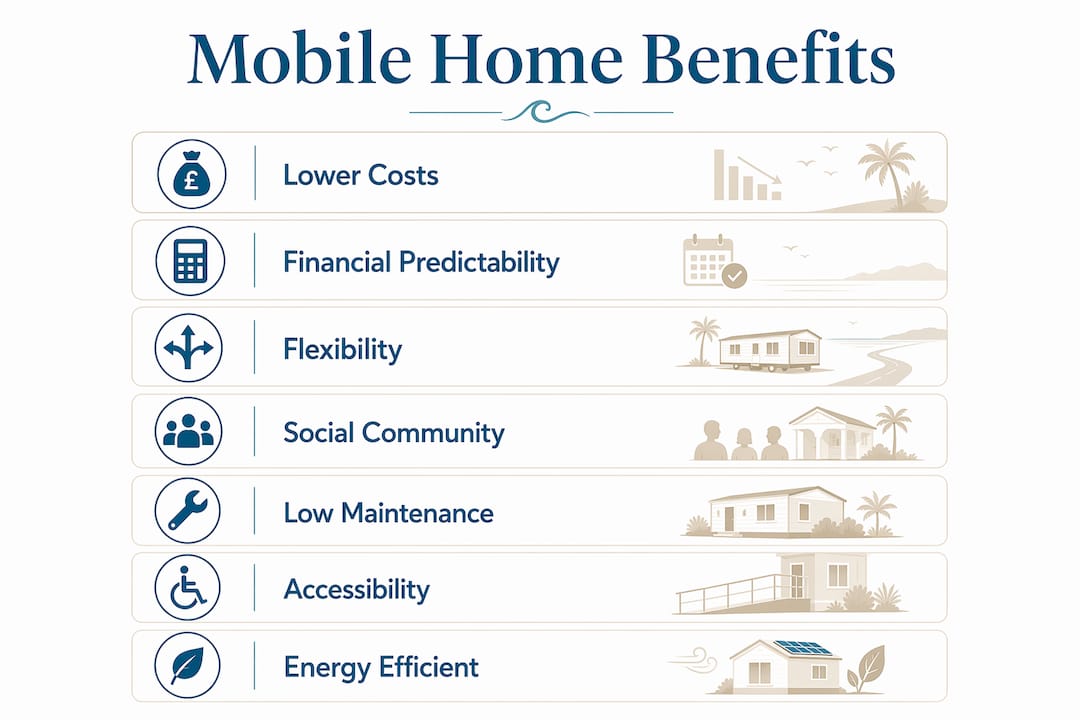
1. Significantly lower housing costs
Manufactured homes can deliver monthly housing costs of £800–£1,200, compared with £2,000–£3,500 for a comparable site-built property. That gap is not trivial when you are managing a fixed income or a pension abroad. The money freed up can fund travel, healthcare, or simply a more comfortable daily life.
2. Financial predictability month to month
Loan payments on a mobile home are typically fixed for the duration of the term. Apartment rents, by contrast, tend to rise annually. Over time, that difference compounds: by year ten of renting, monthly costs can be £550 more than equivalent mobile home ownership costs. For expats planning on a fixed income, that stability is genuinely useful.
3. Flexibility without legal headaches
Owning a mobile home gives you a settled base without locking you into the legal and financial obligations of a traditional property purchase. If your circumstances change, moving on is far simpler than selling a house. This suits expats whose plans may shift with visa requirements, family needs, or retirement timelines.
4. A ready-made social community
Mobile home communities act as integrated social networks, offering shared activities and amenities that help expats connect with neighbours naturally. For anyone arriving in a new country without an existing social circle, that matters. The community structure does much of the integration work for you.
5. Lower maintenance demands
Smaller footprints mean fewer repairs, less cleaning, and lower upkeep costs overall. Shared park management often covers common areas, reducing the burden on individual owners. For expats who travel frequently or spend time between countries, this is a genuine relief.
6. Single-level living and accessibility
Single-level floor plans with wide hallways and the option to add ramps or grab bars make mobile homes well suited to ageing in place. For expats in their fifties and beyond, that adaptability has real long-term value.
7. Sustainability and lower energy use
Modern manufactured homes are built with energy efficiency in mind. Smaller footprints naturally reduce heating and cooling demands, and many newer models include insulated windows and efficient HVAC systems. A smaller ecological footprint is a genuine benefit, not just a selling point.
What are the challenges you should consider?
Mobile home living comes with real trade-offs, and it is worth knowing them before you commit.
- Space limitations: Mobile homes offer less square footage than most traditional houses. Every item needs to earn its place, and storage requires planning.
- Lot rent dependency: Your ongoing costs include lot rent paid to the park owner. Rent increases are the primary financial risk, and the quality of park management directly affects your experience.
- Lower appreciation: Mobile homes are best viewed as lifestyle assets rather than investment vehicles. They do not appreciate at the same rate as site-built properties, so capital growth should not be your expectation.
- Community rules: Parks operate under shared rules covering modifications, pets, noise, and exterior appearance. These vary widely and are worth reading carefully before purchase.
- Planning and legal considerations: Placement of a mobile home is subject to local planning regulations. In the UK, permitted development rights and site licences govern where homes can be located and how they can be used.
- Financing costs: Chattel loans typically carry interest rates of 8–12%, higher than conventional mortgages. Lower purchase prices can offset this, but it is a factor to weigh carefully.
- Lifestyle adjustment: Moving from a city flat or a suburban house to a park home requires a genuine shift in mindset. The pace is quieter, the space is smaller, and the community is closer.
Mobile home living as a lifestyle asset for UK expats
The strongest case for mobile home living is not financial, though the numbers are compelling. It is the combination of predictable costs and genuine community that makes this housing model work so well for expats.
Financial predictability is particularly valuable when you are managing income across currencies or relying on a pension. Primary costs settle into lot rent, utilities, and insurance, with no surprise annual rent hikes of the kind common in apartment leases. That structure lets you plan with confidence.
Park management covering security and common area upkeep also reduces the anxiety of being an absentee owner. If you spend part of the year in the UK and part abroad, knowing your home is in a well-managed community removes a layer of worry that traditional property ownership rarely eliminates.
Choosing the right community matters as much as choosing the right home. A well-managed park with active social programming and stable ownership delivers a very different experience from one with high turnover and neglected facilities. Visit in person, speak to existing residents, and read the site licence carefully.
Pro Tip: Ask the park manager for a history of lot rent increases over the past five years. That single figure tells you more about long-term affordability than any brochure.
For expats considering France specifically, Caravansinfrance offers pre-owned mobile homes in the Vendée at Camping Les Prairies du Lac, a four-star site with heated pools, community activities, and a warm coastal microclimate. The buying process is transparent, with no hidden fees or property taxes, and homes are ready to move into immediately. It is the kind of turnkey arrangement that makes the transition abroad feel straightforward rather than stressful. Browse the available homes in Vendée to see what is currently on offer.
Why mobile homes give you easy access to local life
Location is one of the underrated strengths of mobile home parks. Well-established sites tend to sit within easy reach of local villages, markets, and services, giving residents a genuine connection to the surrounding area rather than the isolation that some expats fear.

Rural and suburban park locations do typically require personal transport, so a car is worth factoring into your plans. In return, you gain access to quieter surroundings, local produce markets, independent shops, and the kind of community life that urban apartment blocks rarely offer. Parks in the Vendée, for example, sit close to Atlantic beaches, weekly markets, and the boulangerie at the end of the road.
Shared amenities within the park itself, including pools, social spaces, and organised activities, mean you do not need to travel far for leisure. That combination of on-site comfort and proximity to local life is one of the reasons mobile home communities appeal so strongly to expats who want to feel genuinely settled rather than merely housed.
Mobile homes suit the expat lifestyle because they solve the right problems: cost, community, and complexity, all at once.
- Affordable entry and lower monthly costs than renting or buying a traditional property
- Flexible ownership without the legal and financial weight of conventional real estate
- Built-in social community easing integration and reducing isolation
- Predictable housing expenses fitting fixed income or pension planning
- Manageable maintenance with park support, well suited to part-time or full-time expat living
Key takeaways
Mobile homes suit the expat lifestyle by combining lower housing costs, financial predictability, and ready-made community in a single, low-complexity ownership model.
| Point | Details |
|---|---|
| Lower monthly costs | Monthly housing costs for mobile home owners can be £800–£1,200, compared with £2,000–£3,500 for a comparable site-built property. |
| Financial predictability | Fixed loan payments and stable lot rent help expats on fixed incomes plan budgets reliably. |
| Community integration | Park communities provide built-in social networks that ease cultural adjustment for new expats. |
| Lifestyle asset, not investment | Mobile homes deliver value through quality of life and reduced costs, not capital appreciation. |
| Manageable maintenance | Smaller footprints and shared park management reduce upkeep burden for part-time or travelling owners. |