
The role of storage facilities at your campsite
Discover the role of storage facilities at your campsite. Ensure safety and convenience with our four-point checklist before your next trip!
The role of storage facilities at your campsite
Campsite storage facilities keep your belongings safe, manage seasonal equipment and protect the immediate outdoor space around your mobile home. Before you commit to a purchase, run four quick checks: confirm access arrangements and opening hours; verify the physical size of any assigned locker, shed or bay; ask about security measures and access-control policy; and establish all recurring fees and notice periods for moving bulky items. CampsitePlanning notes that buyers who plan storage before arrival avoid wasted time and unnecessary admin on move-in day, which is especially relevant when you are buying a ready-to-move-in unit and want to settle in straight away.
Your four-point viewing checklist:
- Access: What are the opening hours? Can you reach your locker or shed independently, or do you need staff assistance?
- Size: Will your intended items actually fit? Measure the assigned space, not just the category label.
- Security: Is there gated entry, coded access, CCTV or individual locks? Ask how permissions are assigned.
- Fees: Is storage included in the pitch fee, or billed separately? Are there notice periods or deposit requirements?
Table of Contents
- What types of storage facilities do campsites offer?
- Why does storage matter when buying a mobile home?
- Pre-purchase storage checklist for UK buyers
- What security and access control should you expect?
- How does good zoning make storage work day-to-day?
- What do storage facilities typically cost, and what sizes are common?
- How do stored items affect your insurance cover?
- Who manages on-site storage, and how are rules enforced?
- Key takeaways
- What buyers often overlook about campsite storage
- Ready-to-move-in mobile homes with clear storage arrangements
- Useful sources and further reading
What types of storage facilities do campsites offer?
The table below covers the most common options you will encounter at a French holiday campsite.
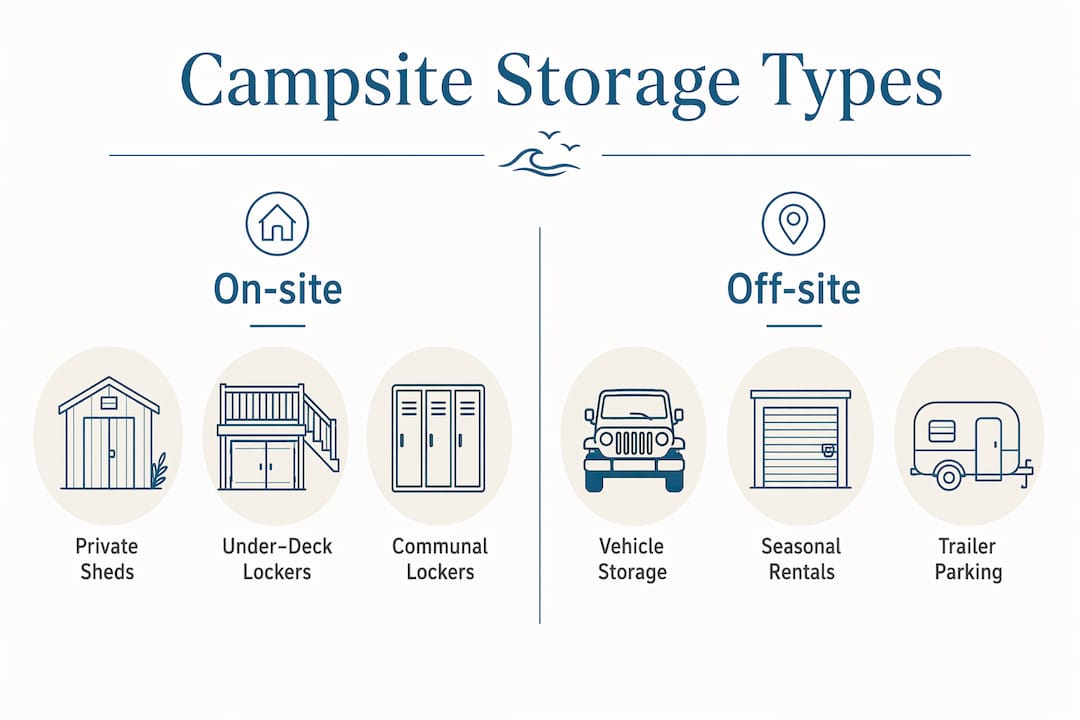
| Facility type | Typical use | Usually included? | Key consideration |
|---|---|---|---|
| Private garden shed | Bikes, folding chairs, seasonal kit | Sometimes | Confirm exact dimensions and lock type |
| Under-deck locker | Small tools, helmets, compact boxes | Often | Check for damp and ventilation |
| Communal locker block | Shared overflow items | Varies | Ask about access hours and key policy |
| Vehicle or boat bay | Car, caravan, boat | Rarely; usually extra fee | Confirm surface, security and notice periods |
| Off-site partner storage | Bulky or long-term items | No | Useful for items left between visits |
Private sheds and under-deck lockers are the most relevant options for mobile-home owners at a site like Camping Les Prairies du Lac. They sit directly on or beside your pitch, so access is immediate. Communal lockers suit occasional overflow but tend to have shared access hours. Vehicle and boat bays are almost always let separately, often at an annual fee. Some campsites offer temperature-controlled units for sensitive equipment, which matters in a coastal Vendée climate where humidity can build quickly between visits.
Off-site storage makes sense when you want to leave a car or a trailer between visits without paying for a full vehicle bay on-site. Ask whether the campsite has a preferred partner and what the handover process involves.
Why does storage matter when buying a mobile home?
Storage directly affects daily comfort, ongoing costs and the future marketability of your mobile home. Poor storage leads to clutter on the pitch, which creates trip hazards and can breach campsite safety rules about clear exit routes. Beyond safety, fabrics, electronics and upholstered furniture left in damp or unventilated spaces deteriorate faster, raising maintenance costs and potentially triggering insurer queries.
Well-documented, secure on-site storage is also a genuine selling point when you eventually come to resell. A pitch with a clearly allocated, lockable shed and a documented access policy is easier to market than one where storage is informal or shared. PMT Security’s guidance on access control confirms that assigning defined permissions reduces accidents and protects equipment, which matters to both owners and future buyers. WildernessSense recommends storage zoning as a way to keep gear clear of pathways and maintain the visual order that makes a site feel well-run.
Pre-purchase storage checklist for UK buyers
Use this list at viewings and in written enquiries to campsite management or your Caravansinfrance contact.
- Confirm permitted items. Ask for a written list of what may and may not be stored.
- Measure the assigned space. Get internal dimensions, not just a category name (“small shed”).
- Check access hours. Are they the same as general site hours, or restricted?
- Establish notice periods. Many campsites require 1–2 weeks’ notice to move heavy items needing machinery or coordinated staff.
- Ask who holds keys or access cards. Confirm whether duplicates are held by management.
- Review CCTV and gate policy. Ask how tiered permissions are assigned and whether access logs are kept.
- Check pest control and climate provision. Is there ventilation? Are desiccants or sealed containers recommended?
- Inspect for damp, mould or pest activity. Look at corners, floor edges and any wooden shelving.
- Request the written storage policy. Ask for the charging schedule, any prior incidents and the campsite’s formal rules.
Suggested email questions to copy: “Could you confirm the internal dimensions of the storage assigned to this pitch, the access hours, any notice period for moving large items, and whether storage fees are included in the pitch licence or billed separately?”
Pro Tip: Ask for a clause in the sale or pitch licence that guarantees agreed storage access terms for a defined period after completion. This is particularly useful when buying a turnkey unit where you are relying on existing arrangements.
What security and access control should you expect?
Security on campsites ranges from a simple padlock on a communal locker to gated perimeters with coded entry and CCTV. The gap between those two extremes matters for your peace of mind and for your insurer.
Standard features to check:
- Gated or fenced perimeter with controlled entry
- Coded keypad or keycard access to storage areas
- CCTV covering storage zones (ask about recording retention)
- Individual locks on private sheds or lockers
- Adequate lighting around storage areas after dark
- On-site staff presence during peak and off-peak periods
PMT Security recommends tiered permissions so that only authorised staff, owners and service providers can reach sensitive infrastructure and private storage. This reduces the campsite operator’s liability and gives you a clearer record if something goes missing. Ask specifically how permissions are assigned when you buy, and whether access logs are available on request.
Operational access matters too. If you arrive on a Friday evening with a car full of kit, can you reach your shed? Ask about out-of-hours access and whether there is a contact number for staff-assisted entry.
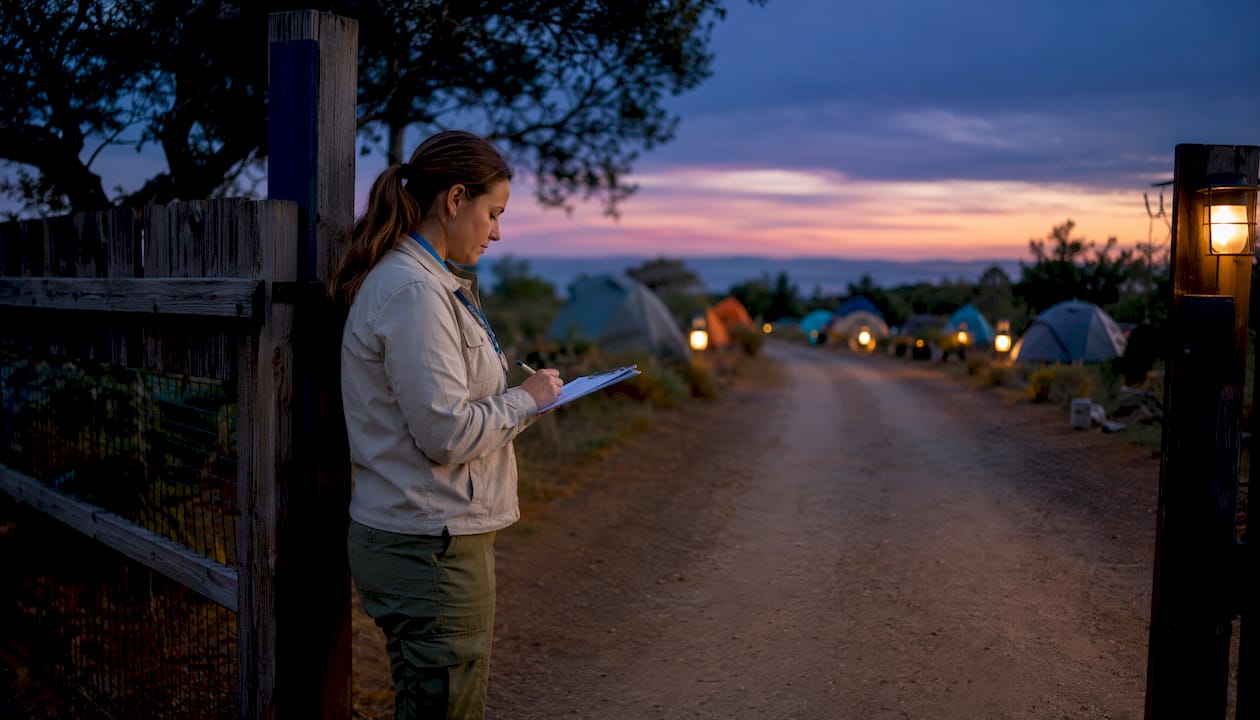
Pro Tip: Request a short walk-round with management before you sign anything. Check camera placement, gate opening logs and whether the staff routine actually covers storage areas. A five-minute tour tells you more than a written policy.
How does good zoning make storage work day-to-day?
Zoning your pitch into activity-specific areas is one of the lowest-cost ways to improve safety and keep your outdoor space looking its best. WildernessSense advocates separating cooking, sleeping and maintenance storage to keep pathways clear and reduce the visual clutter that can make a pitch feel cramped.
Practical storage solutions for mobile-home owners:
- Under-deck organisers for folding chairs, small tools and seasonal items
- Labelled plastic bins with desiccant packs for anything left between visits
- Hanging nets for drying wet gear, keeping it off the ground and out of walkways
- Separate sealed containers for food to deter wildlife and insects
Ask whether the campsite enforces zone boundaries and whether communal storage areas are clearly signed. A well-managed site will have visible signage and regular checks.
Pro Tip: Set up a labelled, colour-coded system for your pitch before your first stay. Include a short seasonal close-down list so family members and any cleaning team can pack items away correctly without needing to ask.
What do storage facilities typically cost, and what sizes are common?
Storage costs vary considerably. Some pitches include a small locker or under-deck space within the pitch fee; others charge a separate annual or seasonal fee for a shed or vehicle bay. Always confirm the charging method, any security deposit and whether fees change between seasons.
Common size categories and what fits:
- Small locker: helmets, tools, a few small boxes
- Under-deck locker: folding chairs, compact camping kit, a small bicycle
- Medium shed: two bicycles, larger camping equipment, seasonal furniture
- Vehicle or boat bay: car, small boat, trailer
Ask for a measurement report or a photograph of the exact locker or shed assigned to your pitch, not just a category description. Sizes vary between pitches even within the same campsite. Also confirm the coordination window for moving large items; as noted above, some sites need advance notice when machinery or staff scheduling is involved.
How do stored items affect your insurance cover?
Insurers treat items stored in on-site facilities differently from belongings inside the mobile home itself. Before you store anything of value, confirm whether your mobile-home policy extends to on-site storage or whether you need separate contents cover.
Insurance checklist for stored items:
- Get written confirmation of cover limits for items in external storage
- Check exclusions for climate damage, condensation or pest activity
- Confirm any lock or approved-storage requirements your insurer imposes
- Ask whether leaving items unattended between visits triggers any policy conditions
- Photograph and catalogue valuables; keep receipts and use desiccants or sealed containers for moisture-sensitive goods
- Check whether the campsite requires a declaration for long-term storage (some need advance notice for maintenance access)
REI’s food-storage guidance recommends metal lockers or sealed containers for scented items because communal storage can attract pests. That principle applies equally to a Vendée campsite, where insects and small wildlife are active through the warmer months.
Who manages on-site storage, and how are rules enforced?
Campsite management controls access policy and maintains communal areas; mobile-home owners are responsible for keeping their pitch tidy and following the site’s storage rules. Understanding that division before you buy saves disputes later.
Typical responsibilities:
- Campsite operator: maintains communal storage areas, applies access controls, manages pest control and enforces fire-safety rules about clear pathways
- Mobile-home owner: maintains private sheds and lockers, adheres to permitted-items rules and keeps the pitch clear of hazards
Enforcement usually follows a staged process: a written warning, then a fine, then removal of items for persistent breaches. Ask for the written policy or the relevant clause in the pitch licence before you sign. Campsite management responsibilities at family-run sites in France often include regular storage-area inspections, which is a positive sign of a well-run operation. Ludo at Caravansinfrance is a useful first point of contact for questions about local practice and any disputed clauses you want to raise during negotiation.
Key takeaways
Good campsite storage facilities protect your belongings, preserve your pitch’s appearance and directly support the resale value of your mobile home — check access, size, security and fees before you sign anything.
| Point | Details |
|---|---|
| Four pre-purchase checks | Confirm access hours, physical dimensions, security measures and all fees before committing. |
| Notice periods matter | Some campsites require 1–2 weeks’ notice to move heavy items; factor this into move-in planning. |
| Insurance gap | Your mobile-home policy may not cover items in external storage; get written confirmation before storing valuables. |
| Get terms in writing | Ask for a clause in the pitch licence guaranteeing agreed storage access for a defined period post-sale. |
| Caravansinfrance listings | Contact Caravansinfrance to see pitches at Camping Les Prairies du Lac with documented storage arrangements. |
What buyers often overlook about campsite storage
Most buyers focus on the mobile home itself and treat storage as an afterthought. That is understandable, but it is also where avoidable problems tend to start.
The most common oversights are straightforward: not measuring the assigned locker before purchase (and discovering a bicycle does not fit), not asking about notice periods for heavy moves (and finding the shed is inaccessible on move-in day), and assuming that on-site security covers everything stored on the pitch (it rarely does without a specific policy clause). Each of these is a five-minute conversation during the viewing, yet most buyers skip it.
What I find more interesting is the zoning question. Buyers rarely ask how the campsite enforces its own storage rules. A site with clear zone boundaries, signed communal areas and regular management checks is a fundamentally different ownership experience from one where rules exist on paper only. That difference shows up in pitch condition, in neighbourly relations and, eventually, in resale appeal. Ask to see the storage policy document, not just hear a verbal summary. If management cannot produce one, that tells you something worth knowing before you sign.
Ready-to-move-in mobile homes with clear storage arrangements
Buying a mobile home should feel like gaining a place in the sun, not inheriting a list of unanswered questions. Caravansinfrance lists ready-to-move-in homes at Camping Les Prairies du Lac in the Vendée, and the team can confirm storage arrangements, access policies and pitch details before you visit. No hidden fees, no complex legalities, just a transparent process from first enquiry to move-in day.
When you get in touch, have a note of your intended stored items, the approximate dimensions you need and your preferred access times. That gives the team everything needed to match you with a pitch where the storage actually works for your life. Browse current listings at Camping Les Prairies du Lac or view an example turnkey unit at Caravansinfrance to see how storage is presented on live offers.
Useful sources and further reading
- PMT Security — access control for campgrounds: explains tiered permissions, liability reduction and what to ask about gate and locker policies.
- WildernessSense — storage zones and organisation: practical guidance on zoning cooking, sleeping and maintenance areas to improve safety and site appearance.
- CampsitePlanning — campsite organisation: owner-preparation tips for reducing stress and speeding up move-in.
- Outdoor Action Plan — campground storage tips: covers climate risk, desiccants, condensation and the benefits of on-site storage services.
- REI — food storage for camping: wildlife-safe storage practices applicable to communal campsite lockers.
- TrailWest — car camping storage tips: packing lists, waterproof bins and pre-planned layouts to reduce pitch clutter.
- For listing-specific storage questions at Camping Les Prairies du Lac, Caravansinfrance is the primary contact.